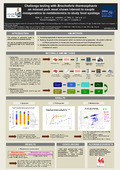
Challenge testing with Brochothrix thermosphacta on minced pork meat shows interest to couple metagenetics to metabolomics to study food spoilage - 2016
[en] The spoilage of perishable foods is mainly caused by bacterial activity. The risk of unwanted bacterial growth is particularly high in the minced pork meat.
In this work, the natural microbial contaminants of the minced pork meat were followed by 16S ribosomal DNA deep sequencing (metagenetics) during aging tests at different temperatures. Brochothrix thermosphacta MM008 strain was selected as one of the main contaminants responsible for the spoilage of the meat.
Minced pork meat previously sterilized by gamma irradiation was inoculated with B. thermosphacta MM008 for challenge tests measuring growth and then incubated at different temperatures. Minced meat samples were taken and analyzed by H-NMR 1D at time 0 and at final time (from 14 to 19 days, depending on the incubation temperature). Orthogonal partial least square discriminant analysis (OPLS-DA) showed that samples, regardless of the incubation temperature, could be splitted into 3 groups according to their spectral profile: 1) samples taken at time 0, 2) samples inoculated with B. thermosphacta and taken at final time, 3) samples uninoculated, taken at final time.
From the analysis of the metabolomics data, higher concentrations of glycerol, glucose, taurine, lactate, carnitine, betaine and glycine were identified in the samples of uninoculated minced pork meat and an increased production of creatine, acetate and acetone was found in the samples of minced pork meat inoculated with B. thermosphacta MM008. These observations showed that -omics technologies (metagenetics and metabolomics) could be used conclusively to study microbial spoilage of minced pork meat.
Disciplines :
Food science
Author, co-author :
Baré, Ghislain ; Université de Liège > Département de sciences des denrées alimentaires (DDA) > Microbiologie des denrées alimentaires
Cauchie, Emilie ; Université de Liège > Département de sciences des denrées alimentaires (DDA) > Analyse des denrées alimentaires
Leenders, Justine ; Université de Liège > Département des sciences cliniques > Labo de biologie des tumeurs et du développement
Tahiri, Assia ; Université de Liège > Département de sciences des denrées alimentaires (DDA) > Microbiologie des denrées alimentaires
Korsak Koulagenko, Nicolas ; Université de Liège > Département de sciences des denrées alimentaires (DDA) > Département de sciences des denrées alimentaires (DDA)
De Tullio, Pascal ; Université de Liège > Département de pharmacie > Chimie pharmaceutique
Daube, Georges ; Université de Liège > Département de sciences des denrées alimentaires (DDA) > Microbiologie des denrées alimentaires
Language :
English
Title :
Challenge testing with Brochothrix thermosphacta on minced pork meat shows interest to couple metagenetics to metabolomics to study food spoilage