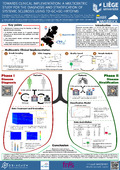
[en] Breathomics, the analysis of volatile organic compounds (VOCs) in exhaled breath, offers a promising non-invasive approach for disease diagnosis and monitoring. Systemic sclerosis (SSc), a rare chronic, heterogeneous autoimmune disease characterized by fibrosis, inflammation, and vascular abnormalities, presents significant diagnostic challenges, particularly in the early detection of interstitial lung disease (ILD), a major contributor to mortality. Despite growing clinical needs, reliable biomarkers for early diagnosis, patient stratification, and disease progression monitoring are still lacking.
In this context, we developed a standardized analytical workflow based on Tedlar bag-based breath sampling, thermal desorption concentration (TD), and comprehensive two-dimensional gas chromatography coupled with high-resolution time-of-flight mass spectrometry (GC×GC-HRTOFMS). This method was applied in a multicentric clinical study involving the University Hospital of Liège (CHU, Belgium) and Maastricht University Medical Center (MUMC+, the Netherlands).
The study involved a total of 62 participants for initial classification (32 SSc patients and 30 healthy subjects), and 42 additional patients for ILD stratification (21 SSc and 21 SSc-ILD). Standard operating procedures (SOPs) and ready-to-use sampling kits were implemented across both centers to ensure analytical consistency and minimize variability. Over 700 VOCs were detected, with 16 compounds distinguishing SSc from healthy controls. For ILD stratification, a robust PLS-DA-based statistical model identified 9 key biomarkers, achieving an AUC of 0.82, 85% accuracy, 77% sensitivity, and 100% specificity. Four of these markers were consistently identified in both studies. More interestingly, a correlation was highlighted between DLco, a commonly used clinical pulmonary test, and the PLS-DA score, validating the classification model developed. Instrumental QC was maintained through routine injection of a 21-compound standard mix, mimicking breath composition.
This study confirms the feasibility and clinical relevance of breathomics in detecting metabolomic perturbations associated with SSc and its complications. The integration of SOPs and multicentric design ensured reproducibility and highlighted the importance of harmonized workflows. Our findings support the use of exhaled breath as a monitoring and stratification tool, paving the way toward clinical implementation of breathomics for personalized management of SSc patients, aiding treatment decisions, as well as offering new insights into metabolic pathways involved.
Disciplines :
Chemistry
Author, co-author :
Massenet, Thibault ; Université de Liège - ULiège > Molecular Systems (MolSys)
Zanella, Delphine ; Université de Liège - ULiège > Département de chimie (sciences) > Chimie analytique, organique et biologique
Potjewijd, Judith; Maastricht University Medical Center > Internal Medicine > Division of Clinical and Experimental Immunology
Tobal, Rachid; Maastricht University Medical Center > Internal Medicine > Division of Clinical and Experimental Immunology
GESTER, Fanny ; Centre Hospitalier Universitaire de Liège - CHU > > Service de pneumologie - allergologie
Henket, Monique ; Centre Hospitalier Universitaire de Liège - CHU > > Service de pneumologie - allergologie