Ribosome, catalytic center, peptide bond formation rate, biophysics, computational biology, protein synthesis
Abstract :
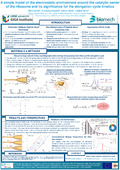
[en] The central function of the large subunit of the ribosome is to catalyze peptide bond formation. This biochemical reaction is conducted at the peptidyl transferase center (PTC). Experimental evidence shows that the catalytic activity is affected by the electrostatic environment around the peptidyl transferase center. Here, we set up a minimal geometrical model fitting the available X-ray solved structures of the ribonucleoproteic cavity around the catalytic center of the large subunit of the ribosome. The purpose of this phenomenological model is to estimate quantitatively the electrostatic potential and electric field that are experienced during the peptidyl transfer reaction. At least two reasons motivate the need for developing this quantification. First, we inquire whether the electric field in this particular catalytic environment, made only of nucleic acids, is of the same order of magnitude as the one prevailing in catalytic centers of the proteic enzymes counterparts. Second, the protein synthesis rate is dependent on the nature of the amino acid sequentially incorporated in the nascent chain. The activation energy of the catalytic reaction and its detailed kinetics are shown to be dependent on the mechanical work exerted on the amino acids by the electric field, especially when one of the four charged amino acid residues (R, K, E, D) is newly incorporated in the nascent chain. Physical values of the electric field provide quantitative knowledge of mechanical work, activation energy and rate of the peptide bond formation catalyzed by the ribosome. We show that our theoretical calculations are consistent with two independent sets of previously published experimental results. Experimental results for E.coli in the minimal case of the dipeptide bond formation when puromycin is used as the final amino acid acceptor strongly support our theoretically derived reaction time courses. Experimental Ribo-seq results on S. cerevisiae and E.coli comparing the residence time distribution of ribosomes upon specific codons are also well accounted for by our theoretical calculations. Our interpretation of these results sheds light on the functional role of the electrostatic profile around the PTC and its impact on the ribosome elongation cycle.
Rapino, Francesca ; Université de Liège - ULiège > GIGA > GIGA Stem Cells - Cancer Signaling
Close, Pierre ; Université de Liège - ULiège > GIGA > GIGA Stem Cells - Cancer Signaling
Geris, Liesbet ; Université de Liège - ULiège > GIGA > GIGA In silico medecine - Biomechanics Research Unit
Language :
English
Title :
A simple model of the electrostatic environment around the catalytic center of the ribosome and its significance for the elongation kinetics
Publication date :
06 September 2022
Event name :
Translational Control meeting
Event organizer :
Cold Spring Harbor Laboratory
Event place :
Cold Spring Harbor, New-York, United States - New York
Event date :
from September 6 to September 10, 2022
Audience :
International
Peer review/Selection committee :
Editorial reviewed
Funders :
EOS - The Excellence Of Science Program ERC - European Research Council
Funding number :
FNRS-FWO EOS grant n° 30480119 (Join-t-against-Osteoarthritis); European Research Council under the European Union's Horizon 2020 Framework Program (H2020/2014-2020) /ERC grant agreement n°772418 (INSITE)