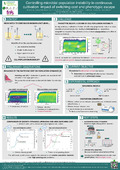
[en] Continuous cultivation offers a promising alternative to batch and fed-batch processes by enabling
sustained production and reduced downtime. However, its broader application is limited by
population instability, affecting both productivity and process robustness. While such instability is
often attributed to genetic mutations, increasing evidence highlights the role of phenotypic
heterogeneity within isogenic populations [1]. In this context, phenotypic escape emerges as a
rapid and reversible process leading to subpopulations with reduced gene expression [2].
To investigate phenotypic escape, low and high switching cost systems were compared using
Escherichia coli BL21 (low switching cost) and BL21(DE3) (high switching cost). Switching cost
is defined as the reduction in growth rate associated with the activation of a target gene circuit. In
E. coli BL21(DE3), lactose induces the T7 expression system, resulting in a significant growth
penalty and thus a high switching cost. Preliminary experiments in microtiter plate cultures with
glucose-lactose mixtures revealed classical diauxic growth with two exponential phases under
low switching cost conditions, mainly due to adaptation from glucose to lactose. Interestingly, high
switching cost conditions resulted in an unexpected third exponential phase, suggesting complex
population dynamics. These results indicate that switching cost may promote phenotypic
diversification and contribute to phenotypic escape.
Future work will combine lab-scale bioreactor cultures with automated flow cytometry to clarify
the relationship between switching cost, phenotypic escape, and population instability. Ultimately,
this work aims to provide new insights into controlling heterogeneity in continuous cultures, paving
the way for more robust and predictable biomanufacturing systems.
Research Center/Unit :
TERRA Research Centre. Microbial technologies - ULiège
Disciplines :
Biotechnology Microbiology
Author, co-author :
Sloodts, Alizée ; Université de Liège - ULiège > TERRA Research Centre > Microbial technologies
Telek, Samuel ; Université de Liège - ULiège > Département GxABT > Microbial technologies
Zicler, Andrew ; Université de Liège - ULiège > Département GxABT > Microbial technologies
Delvigne, Frank ; Université de Liège - ULiège > Département GxABT > Microbial technologies
Language :
English
Title :
Controlling microbial population instability in continuous cultivation: impact of switching cost and phenotypic escape
Alternative titles :
[fr] Contrôle de l'instabilité des populations microbiennes en culture continue: impact du coût de transition d'état phénotypique (switching cost) et de la fuite phénotypique
Original title :
[en] Controlling microbial population instability in continuous cultivation: impact of switching cost and phenotypic escape
Publication date :
June 2026
Number of pages :
1
Event name :
Advanced Fermentation Technology 2026: New frontiers in Industrial Biotechnology