Abstract :
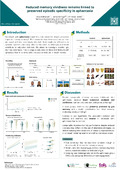
[en] Episodic memories in individuals with aphantasia (i.e., the lack of voluntary mental imagery) may be qualitatively different from typical imagers: despite equivalent accuracy, they are less detailed and more semantically focused (Bainbridge et al., 2021). The subjective experience of remembering is also reduced, with memories being, on average, less vivid (Siena & Simons, 2024). In our study, we expected subjective vividness ratings to be more strongly mediated by gist memory (i.e., general information) in individuals with aphantasia than in control participants. Adapting the paradigm developed by Cooper & Ritchey (2022), 72 participants with aphantasia (VVIQ score ≤ 32) and 71 controls completed an online recognition memory task. Participants encoded thematic word sets associated with three elements, each presented as an image paired with its name: a famous person, an object, and a place. Memory was subsequently assessed for gist (name recognition) and visual details (image discrimination), alongside trial-by-trial subjective vividness ratings. As expected, participants with aphantasia experienced their memories as less vivid, despite being equally accurate as controls. Participants with aphantasia appeared to rely on the same level of memory specificity when evaluating subjective vividness: vividness was more strongly associated with gist memory, with a weaker but additive contribution of detail memory, similarly to control participants. Contrary to our hypothesis, the association between gist memory and vividness was weaker in individuals with aphantasia than in controls. This group difference may suggest that individuals with aphantasia rely on other cues when evaluating subjective vividness, potentially contributing to their reduced sense of reliving.