Abstract :
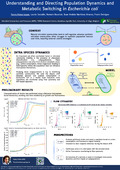
[en] In recent years, microbial communities have attracted increasing interest in biotechnology due to their potential to produce complex molecules, drawing growing attention from the industrial sector. However, the implementation and exploitation of such systems still face several fundamental bottlenecks. Unlike natural microbial communities, synthetic communities, sometimes composed of bioengineered organisms, lack the robustness necessary to maintain the relative proportions of their different populations over time, requiring strictly regulated bioprocesses. To address this challenge, it is necessary to understand the principles governing population dynamics, both in monoculture and in co-culture. While inter-species interactions represent a central component of population dynamics, intra-species dynamics should not be overlooked as they can lead to an imbalance of the system1. To reach the complexity of highly structured co-cultures, we need to begin with establishing a mechanistic understanding of subpopulation dynamics in monocultures. In this context, the glucose–acetate diauxic shift in Escherichia coli represents a well-documented and relevant model system.
In this system, when E. coli grows at a high rate of glucose consumption, part of this carbon source is converted into acetate and excreted. Once glucose becomes available at lower concentrations while acetate is present in the medium, a fraction of the E. coli population undergoes a metabolic switch, enabling the uptake of acetate as an additional carbon source2. This leads to the emergence of two subpopulations differing in their substrate utilisation. While the heterogeneity of these subpopulations has been well documented in spatially structured systems, notably using microfluidic setups, its temporal evolution remains poorly characterised in homogeneous systems such as continuous cultures in bioreactors, which more closely reflect industrial production conditions. The first step of this work is therefore to characterise the temporal emergence of the acetate-consuming subpopulation and its dynamic interplay with the glucose-consuming subpopulation during continuous cultivation in a bioreactor.
To monitor these subpopulations, the acs gene, which is exclusively activated during acetate uptake, was selected and coupled to the expression of GFP (Green Fluorescent Protein). This approach enables real-time visualization and tracking of the appearance and level of the acetate-consuming subpopulation using online flow cytometry analysis. Once the emergence and temporal evolution of the glucose- and acetate-consuming subpopulations have been characterised, this knowledge can be leveraged to move toward the regulation of subpopulation composition. To this end, we will use the Segregostat, developed within our team, which enables real-time monitoring of subpopulation dynamics in continuous culture and adjustment of subpopulation composition through the addition of substrate pulses.
1. Delvigne, F., Zune, Q., Lara, A. R., Al-Soud, W. & Sørensen, S. J. Metabolic variability in bioprocessing: implications of microbial phenotypic heterogeneity. Trends in Biotechnology 32, 608–616 (2014).
2. Nikolic, N., Barner, T. & Ackermann, M. Analysis of fluorescent reporters indicates heterogeneity in glucose uptake and utilization in clonal bacterial populations. BMC Microbiol 13, 258 (2013).