Abstract :
[en] Meat freshness is critical for food safety, nutritional quality, and consumer
satisfaction, yet conventional physicochemical and microbiological methods are
complex, time-consuming, and unsuitable for real-time monitoring. To address this,
we developed a rapid, portable, and highly sensitive electrochemical sensing strategy
based on single- and dual-atom nanozymes, systematically investigating the effects of
metal centers and structural configurations on enzyme-like catalytic activity.
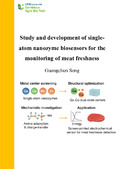
Single-atom nanozymes (SAzymes) containing Ga, Cu, Mn, and Zn were
synthesized and evaluated for peroxidase-, oxidase-, superoxide dismutase-, and
catalase-like activities, as well as catalytic efficiency, electron transfer, and stability.
Ga SAzyme exhibited the highest multi-enzyme activity, while Cu SAzyme excelled
in catalase-like behavior, indicating the dominant roles of Ga and Cu.
Dual-atom Ga-Cu nanozymes supported on layered double hydroxides (GaCu-LDH)
showed enhanced peroxidase- and oxidase-like activities due to synergistic metal
interactions and high-surface-area support. Mechanistic studies combining density
functional theory and experiments revealed that Cu-N bond formation governs
adsorption of volatile biogenic amines, with significant electron transfer between
dual-metal centers and substrates. In situ Fourier-transform infrared spectroscopy
(FTIR) and Kelvin probe force microscopy (KPFM) confirmed electronic structure
reconstruction, emphasizing the critical role of dual-metal synergy.
A screen-printed GaCu-LDH electrochemical chip was integrated into a handheld
sensor, which exhibited rapid response (≈ 4 s), high selectivity, and excellent stability.
Current signals correlated strongly (R2 > 0.85) with total volatile basic nitrogen levels
in pork, beef, mutton, and chicken.
In summary, through metal center screening, dual-atom structural optimization,
mechanistic elucidation, and application validation, this study demonstrates the
advantages of Ga-Cu dual-atom nanozymes in multi-enzyme catalysis and electron
transfer, providing a portable, efficient platform for meat freshness assessment and
food safety monitoring.