Abstract :
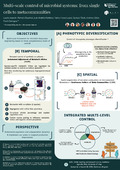
[en] Microbial systems operate through multiple layers of organization, from single-cell dynamics to community-level interactions, yet bioprocess control rarely accounts for this complexity. We propose a multi-scale framework for microbial bioprocess engineering based on three complementary levels of control: (i) regulation of intraspecies phenotypic diversification, (ii) temporal control of synthetic co-cultures, and (iii) spatial structuring of microbial communities through interconnected bioreactor systems.
At the first level, we investigate monocultures carrying burdensome genetic circuits that generate strong phenotypic heterogeneity. Subpopulations differ markedly in growth, metabolism and expression burden. Using real-time single-cell monitoring based on GFP transcriptional reporters coupled with feedback regulation, we examine how metabolic pressure and gene expression constraints shape population dynamics, providing a mechanistic basis for stabilizing production phenotypes under continuous cultivation 1,2.
At the second level, we extend control to microbial co-cultures by dynamically modulating metabolic niches. The AAMN (Automated Adjustment of Metabolic Niches) strategy uses automated alternation of substrate availability to temporally segregate growth phases and stabilize species proportions. Cytometric discrimination via forward- and side-scatter enables high-frequency tracking of species composition, revealing how niche partitioning and division of labor can be engineered to support stable and productive consortia 3,4.
The third level focuses on spatial organization through Continuous Culture of Metacommunities (CCMN). By connecting multiple bioreactors into modular networks, each representing a distinct ecological compartment, microbial consortia can be structured via controlled dispersal and metabolite fluxes. Ongoing work aims to identify CCMN configurations that best support metacommunity stability and functional stratification, opening avenues for designing spatially organized bioprocesses inspired by natural ecosystems.
Together, these levels outline a roadmap for next-generation microbial bioprocesses, integrating single-cell heterogeneity, ecological interactions and spatial structuring to build predictive and adaptive microbial systems.
1. Nguyen, T. M. et al. Reducing phenotypic instabilities of a microbial population during continuous cultivation based on cell switching dynamics. Biotechnol. Bioeng. 118, 3847–3859 (2021).
2. Sassi, H. et al. Segregostat: a novel concept to control phenotypic diversification dynamics on the example of Gram‐negative bacteria. Microb. Biotechnol. 12, 1064–1075 (2019).
3. Martinez, J. A. et al. Controlling microbial co-culture based on substrate pulsing can lead to stability through differential fitness advantages. PLOS Comput. Biol. 18, e1010674 (2022).
4. Martinez, J. A. et al. Automated adjustment of metabolic niches enables the control of natural and engineered microbial co-cultures. Trends Biotechnol. 43, 1116–1139 (2025).