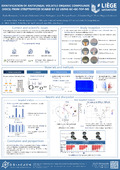
[en] Plant pathogens significantly impact global food production, causing major crop losses. Due to the environmental and health risks of synthetic fungicides, alternative solutions are needed. Streptomyces scabiei 87-22 produces volatile organic compounds (VOCs) with strong antifungal properties. This study aimed to identify VOCs inhibiting Alternaria solani, Gibberella zeae, and Penicillium sp. NS1.
Streptomyces scabiei was co-cultured with these pathogens in five different media, showing varying inhibition levels. Headspace analysis using SPME and GC×GC-TOF-MS allowed VOC identification. A Tile-based approach and both targeted and non-targeted analyses led to the discovery of five key VOCs, whose antifungal effects were confirmed through in-vitro tests.
The study highlights GC×GC-TOF-MS as a powerful tool for analyzing complex microbial VOCs and supports the development of eco-friendly biofungicides.
Disciplines :
Chemistry
Author, co-author :
Bensaada, Djulia ; Université de Liège - ULiège > Département de chimie (sciences) > Chimie analytique, organique et biologique