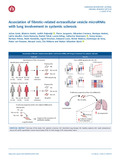
[en] [en] BACKGROUND: There is a pressing need to identify early biomarkers of lung involvement in systemic sclerosis (SSc) to start as soon as possible antifibrotic therapy. We aimed to identify extracellular vesicle-derived microRNAs (EV-miRNAs) that are differentially expressed between SSc patients with and without interstitial lung disease (ILD), explore their diagnostic value and investigate their functional properties.
METHODS: Small EVs (sEVs) derived from plasma were isolated from 91 well-characterised SSc patients with ILD (SSc-ILD, n=45), without ILD (SSc-no ILD, n=46) and 43 matched healthy subjects (HS). Small RNA sequencing followed by quantitative RT-PCR were used to identify and validate sEV-miRNAs associated to SSc-ILD. Correlations between SSc-ILD-associated miRNAs and clinical parameters were assessed, as well as the impact of related miRNAs/sEVs on fibrosis.
RESULTS: We identified a 4-miRNA signature associated with ILD in SSc context (miR-584-5p, miR-744-5p, miR-1307-3p and miR-10b-5p) (ROC AUC=0.85, 95% CI 0.76-0.94, p<0.0001). Deeper analysis revealed a correlation of these candidates with pulmonary function tests (DLCO and FVC), highlighting their capacity to monitor lung fibrosis progression in SSc patients. Furthermore, SSc-ILD-associated sEV miRNAs are positively correlated and enriched in circulating lymphocytes, suggesting that these immune cells are their cellular source. Finally, functional studies highlighted an alteration of functional properties of sEVs in SSc-ILD context mainly due to the transfer of profibrotic miR-584-5p in lung fibroblasts.
CONCLUSIONS: Our sEV-based biomarker approach enabled to identify a promising 4-miRNA signature characteristic of ILD in SSc patients. Furthermore, the profibrotic properties of SSc-ILD-associated sEVs suggest a prominent role of these vesicles on SSc severity.
Disciplines :
Cardiovascular & respiratory systems
Author, co-author :
Guiot, Julien ; Université de Liège - ULiège > Département des sciences cliniques > Pneumologie - Allergologie
André, Béatrice ; Université de Liège - ULiège > Département des sciences cliniques
Potjewijd, Judith ; Department of Internal Medicine, Division Clinical and Experimental Immunology, Internal Medicine, Maastricht University Medical Center, Maastricht, the Netherlands
JACQUERIE, Pierre ; Centre Hospitalier Universitaire de Liège - CHU > > Service de rhumatologie
Cremers, Sébastien ; Université de Liège - ULiège > Département des sciences cliniques > Pneumologie - Allergologie
Henket, Monique ; Centre Hospitalier Universitaire de Liège - CHU > > Service de pneumologie - allergologie
Idoufkir, Latifa ; Université de Liège - ULiège > Département des sciences cliniques > Pneumologie - Allergologie
Remacle, Claire ; Université de Liège - ULiège > Département des sciences de la vie
Tobal, Rachid; Department of Internal Medicine, Division Clinical and Experimental Immunology, Internal Medicine, Maastricht University Medical Center, Maastricht, the Netherlands
GILTAY, Laurie ; Centre Hospitalier Universitaire de Liège - CHU > > Service de pneumologie - allergologie
GESTER, Fanny ; Centre Hospitalier Universitaire de Liège - CHU > > Service de pneumologie - allergologie
Polese, Barbara ; Université de Liège - ULiège > Département des sciences biomédicales et précliniques
Hamaïdia, Malik ; Université de Liège - ULiège > Département GxABT > Microbial technologies
Struman, Ingrid ; Université de Liège - ULiège > GIGA > GIGA Cancer - Molecular Angiogenesis
Louis, Edouard ; Université de Liège - ULiège > Département des sciences cliniques > Hépato-gastroentérologie
Malaise, Michel ; Université de Liège - ULiège > Département des sciences cliniques
de Seny, Dominique ; Université de Liège - ULiège > Département des sciences biomédicales et précliniques
van Paassen, Pieter; Department of Internal Medicine, Division Clinical and Experimental Immunology, Internal Medicine, Maastricht University Medical Center, Maastricht, the Netherlands
Louis, Renaud ; Université de Liège - ULiège > Département des sciences cliniques > Pneumologie - Allergologie
Ribbens, Clio ; Université de Liège - ULiège > Département des sciences cliniques > Rhumatologie
Petelytska L, Bonomi F, Cannistrà C, et al. Heterogeneity of determining disease severity, clinical course and outcomes in systemic sclerosis-associated interstitial lung disease: a systematic literature review. RMD Open 2023; 9: e003426.
Khanna D, Tashkin DP, Denton CP, et al. Etiology, risk factors, and biomarkers in systemic sclerosis with interstitial lung disease. Am J Respir Crit Care Med 2020; 201: 650–660.
Hoffmann-Vold A-M, Fretheim H, Halse A-K, et al. Tracking impact of interstitial lung disease in systemic sclerosis in a complete nationwide cohort. Am J Respir Crit Care Med 2019; 200: 1258–1266.
Perelas A, Silver RM, Arrossi AV, et al. Systemic sclerosis-associated interstitial lung disease. Lancet Respir Med 2020; 8: 304–320.
Guler SA, Winstone TA, Murphy D, et al. Does systemic sclerosis-associated interstitial lung disease burn out? Specific phenotypes of disease progression. Ann Am Thorac Soc 2018; 15: 1427–1433.
Distler O, Assassi S, Cottin V, et al. Predictors of progression in systemic sclerosis patients with interstitial lung disease. Eur Respir J 2020; 55: 1902026.
Welsh JA, Goberdhan DCI, O’Driscoll L, et al. Minimal information for studies of extracellular vesicles (MISEV2023): from basic to advanced approaches. J Extracell Vesicles 2024; 13: e12404.
Zhou B, Xu K, Zheng X, et al. Application of exosomes as liquid biopsy in clinical diagnosis. Sig Transduct Target Ther 2020; 5: 1–14.
Guiot J, Cambier M, Boeckx A, et al. Macrophage-derived exosomes attenuate fibrosis in airway epithelial cells through delivery of antifibrotic miR-142-3p. Thorax 2020; 75: 870–881.
He L, Hannon GJ. MicroRNAs: small RNAs with a big role in gene regulation. Nat Rev Genet 2004; 5: 522–531.
Baek D, Villén J, Shin C, et al. The impact of microRNAs on protein output. Nature 2008; 455: 64–71.
Njock M-S, O’Grady T, Nivelles O, et al. Endothelial extracellular vesicles promote tumour growth by tumour-associated macrophage reprogramming. J Extracell Vesicles 2022; 11: e12228.
Fujita Y, Araya J, Ito S, et al. Suppression of autophagy by extracellular vesicles promotes myofibroblast differentiation in COPD pathogenesis. J Extracell Vesicles 2015; 4: 28388.
Guiot J, Struman I, Louis E, et al. Exosomal miRNAs in lung diseases: from biologic function to therapeutic targets. J Clin Med 2019; 8: 1345.
Njock M-S, Guiot J, Henket MA, et al. Sputum exosomes: promising biomarkers for idiopathic pulmonary fibrosis. Thorax 2019; 74: 309–312.
Ohlstrom DJ, Sul C, Vohwinkel CU, et al. Plasma microRNA and metabolic changes associated with pediatric acute respiratory distress syndrome: a prospective cohort study. Sci Rep 2022; 12: 14560.
Parzibut G, Henket M, Moermans C, et al. A blood exosomal MiRNA signature in acute respiratory distress syndrome. Front Mol Biosci 2021; 8: 640042.
van den Hoogen F, Khanna D, Fransen J, et al. 2013 classification criteria for systemic sclerosis: an American College of Rheumatology/European League Against Rheumatism collaborative initiative. Arthritis Rheum 2013; 65: 2737–2747.
Lescoat A, Lecureur V, Roussel M, et al. CD16-positive circulating monocytes and fibrotic manifestations of systemic sclerosis. Clin Rheumatol 2017; 36: 1649–1654.
Mathai SK, Gulati M, Peng X, et al. Circulating monocytes from systemic sclerosis patients with interstitial lung disease show an enhanced profibrotic phenotype. Lab Invest 2010; 90: 812–823.
Abraham DJ, Varga J. Scleroderma: from cell and molecular mechanisms to disease models. Trends Immunol 2005; 26: 587–595.
Vreca M, Andjelkovic M, Tosic N, et al. Impact of alterations in X-linked IRAK1 gene and miR-146a on susceptibility and clinical manifestations in patients with systemic sclerosis. Immunol Lett 2018; 204: 1–8.
Sakoguchi A, Jinnin M, Makino T, et al. The miR-146a rs2910164 C/G polymorphism is associated with telangiectasia in systemic sclerosis. Clin Exp Dermatol 2013; 38: 99–100.
Pashangzadeh S, Motallebnezhad M, Vafashoar F, et al. Implications the role of miR-155 in the pathogenesis of autoimmune diseases. Front Immunol 2021; 12: 669382.
Xu W-D, Feng S-Y, Huang A-F. Role of miR-155 in inflammatory autoimmune diseases: a comprehensive review. Inflamm Res 2022; 71: 1501–1517.
Artlett CM, Sassi-Gaha S, Hope JL, et al. Mir-155 is overexpressed in systemic sclerosis fibroblasts and is required for NLRP3 inflammasome-mediated collagen synthesis during fibrosis. Arthritis Res Ther 2017; 19: 144.
Christmann RB, Wooten A, Sampaio-Barros P, et al. miR-155 in the progression of lung fibrosis in systemic sclerosis. Arthritis Res Ther 2016; 18: 155.
Han L, Lv Q, Guo K, et al. Th17 cell-derived miR-155-5p modulates interleukin–17 and suppressor of cytokines signaling 1 expression during the progression of systemic sclerosis. J Clin Lab Anal 2022; 36: e24489.
Lu W, Guo Y, Liu H, et al. The inhibition of fibrosis and inflammation in obstructive kidney injury via the miR-122-5p/SOX2 axis using USC-Exos. Biomater Res 2024; 28: 0013.
Kaneko S, Yanai K, Ishii H, et al. miR-122-5p regulates renal fibrosis in vivo. Int J Mol Sci 2022; 23: 15423.
Liang H. The antifibrotic effects and mechanisms of microRNA-26a action in idiopathic pulmonary fibrosis. Mol Ther 2014; 22: 1122–1133.
Bala S, Zhuang Y, Nagesh PT, et al. Therapeutic inhibition of miR-155 attenuates liver fibrosis via STAT3 signaling. Mol Ther Nucleic Acids 2023; 33: 413–427.
Sato S, Fujimoto M, Hasegawa M, et al. Altered B lymphocyte function induces systemic autoimmunity in systemic sclerosis. Mol Immunol 2004; 41: 1123–1133.
Lipsky PE. Systemic lupus erythematosus: an autoimmune disease of B cell hyperactivity. Nat Immunol 2001; 2: 764–766.
Li J, Wan Y, Guo Q, et al. Altered microRNA expression profile with miR-146a upregulation in CD4+ T cells from patients with rheumatoid arthritis. Arthritis Res Ther 2010; 12: R81.
Stanczyk J, Pedrioli DML, Brentano F, et al. Altered expression of microRNA in synovial fibroblasts and synovial tissue in rheumatoid arthritis. Arthritis Rheum 2008; 58: 1001–1009.
Tu J, Han D, Fang Y, et al. MicroRNA-10b promotes arthritis development by disrupting CD4+ T cell subtypes. Mol Ther Nucleic Acids 2022; 27: 733–750.
Ramanujan SA, Cravens EN, Krishfield SM, et al. Estrogen-induced hsa-miR-10b-5p is elevated in T cells from patients with systemic lupus erythematosus and down-regulates serine/arginine-rich splicing factor 1. Arthritis Rheumatol 2021; 73: 2052–2058.
Shuai Y, Xu N, Zhao C, et al. MicroRNA-10 family promotes renal fibrosis through the VASH-1/Smad3 pathway. Int J Mol Sci 2024; 25: 5232.
Gracia T, Wang X, Su Y, et al. Urinary exosomes contain microRNAs capable of paracrine modulation of tubular transporters in kidney. Sci Rep 2017; 7: 40601.
Wang C, Shuai Y, Zhao C, et al. MicroRNA-10 family promotes the epithelial-to-mesenchymal transition in renal fibrosis by the PTEN/Akt pathway. Curr Issues Mol Biol 2022; 44: 6059–6074.
Jung SM, Park K-S, Kim K-J. Integrative analysis of lung molecular signatures reveals key drivers of systemic sclerosis-associated interstitial lung disease. Ann Rheum Dis 2022; 81: 108–116.
Hinz B, Lagares D. Evasion of apoptosis by myofibroblasts: a hallmark of fibrotic diseases. Nat Rev Rheumatol 2020; 16: 11–31.
Liu R–M, Liu G. Cell senescence and fibrotic lung diseases. Exp Gerontol 2020; 132: 110836.
Abdelfattah N, Rajamanickam S, Panneerdoss S, et al. MiR-584-5p potentiates vincristine and radiation response by inducing spindle defects and DNA damage in medulloblastoma. Nat Commun 2018; 9: 4541.
Kleemann M, Schneider H, Unger K, et al. MiR-744-5p inducing cell death by directly targeting HNRNPC and NFIX in ovarian cancer cells. Sci Rep 2018; 8: 9020.
Tran K-V, Tanriverdi K, Aurigemma GP, et al. Circulating extracellular RNAs, myocardial remodeling, and heart failure in patients with acute coronary syndrome. J Clin Transl Res 2019; 5: 33–43.
Li Q, Li Z, Wei S, et al. Overexpression of miR-584-5p inhibits proliferation and induces apoptosis by targeting WW domain-containing E3 ubiquitin protein ligase 1 in gastric cancer. J Exp Clin Cancer Res 2017; 36: 59.
Garo LP, Murugaiyan G. Contribution of microRNAs to autoimmune diseases. Cell Mol Life Sci 2016; 73: 2041–2051.
Yang E, Hong Y, Xuan C, et al. Biomarker of pulmonary inflammatory response in LUAD: miR-584-5p targets RAB23 to suppress inflammation induced by LPS in A549 cells. Protein Pept Lett 2023; 30: 877–890.
Pilson Q, Smith S, Jefferies CA, et al. miR-744-5p contributes to ocular inflammation in patients with primary Sjogrens syndrome. Sci Rep 2020; 10: 7484.
Zhang X, Han X, Tang Y, et al. miR-744 enhances type I interferon signaling pathway by targeting PTP1B in primary human renal mesangial cells. Sci Rep 2015; 5: 24.
Wermuth PJ, Piera-Velazquez S, Jimenez SA. Exosomes isolated from serum of systemic sclerosis patients display alterations in their content of profibrotic and antifibrotic microRNA and induce a profibrotic phenotype in cultured normal dermal fibroblasts. Clin Exp Rheumatol 2017; 35: Suppl. 106, 21–30.
Nakamura K, Jinnin M, Harada M, et al. Altered expression of CD63 and exosomes in scleroderma dermal fibroblasts. J Dermatol Sci 2016; 84: 30–39.
Leleu D, Levionnois E, Laurent P, et al. Elevated circulatory levels of microparticles are associated to lung fibrosis and vasculopathy during systemic sclerosis. Front Immunol 2020; 11: 532177.
Corallo C, Cutolo M, Soldano S, et al. Exosomes derived from plasma of systemic sclerosis (SSc) patients and from SSc cultured fibroblasts contain pro-fibrotic miRNA signatures and could induce myofibroblast differentiation in vitro. Ann Rheum Dis 2020; 79: 1091–1092.