Abstract :
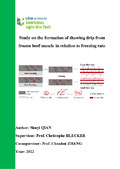
[en] Freezing meat for preservation has been practiced for a long period, since it can effectively extend shelf-life by inhibiting microbial activity and reducing biochemical reactions. To eat meat which has been frozen, thawing becomes an inevitable procedure before most subsequent processing. However, quality deterioration, particularly drip loss always occurs with the thawing process, causing both economic and nutritional disadvantages. To minimize this quality loss, previous researches have validated the effects of freezing rate on amount of thaw loss produced. However, the mechanisms behind the formation of thawing drip had still to be revealed. To this end, the present study aimed to provide new insights as below.
Firstly, three freezing conditions (slow freezing, fast freezing and ultra-fast freezing) have been designed to assess the effects of freezing rate on the development of ice crystallization and protein denaturation. Particular attention was paid to the evolution of water status in frozen/thawed muscle. Results showed that a rather narrow distribution of ice crystals size was formed in ultra-fast freezing at -80 ℃, resulting in less damage to the muscle fibres together with less severe myofibrillar protein denaturation. On the contrary, widened spaces between muscle fibres were observed in slow freezing samples at -18 ℃ due to the growth of ice crystals with large size, which led to a tremendous protein denaturation and a decreased water-holding of myofibrils. After freeze-thaw, 2D T1-T2 relaxation spectra indicated a redistribution of water in muscle, in which slow freezing led to major migration of water from immobile water to free water. Additionally, the proton density images displayed major free water seep from myofibrils to the surface of muscle. In this regard, the water from the “reservoir” (free water) flowed into the “channel” (the widened spaces between muscle fibres), and further contributed to the thawing drip.
Subsequently, attention was turned to the thawing procedure as drip loss mainly occurs during thawing. This part of thesis studied the effects of freezing rate on changes in the myofibrillar protein properties and its interaction with muscle water during thawing. At freezing stage, the growth of ice crystals induced an increase in ionic strength (decline in muscle pH), which led to cold unfolding of myofibrillar protein. However, upon thawing, the protein acted to “renaturate” in the case of ice crystals melting and pH returning to normal level, as evidenced by the increasing solubility, decreasing surface hydrophobicity, increasing thermal stability and gradually stabilizing secondary structure of protein. Although the increasing water-holding of myofibrils indicated that water molecules were re-absorbed during thawing process, the thawing drip emerged continually. This was attributed to the counterbalanced effects of increasing water mobility as presented by LF-NMR results. Under fast freezing, less extensive protein cold denaturation and lower water mobility were found during thawing. Besides, the microenvironment of lower ionic strength in fast freezing should benefit the protein renaturation and water re-absorption, ultimately contributing to lower thaw loss.
As reported before, freezing rate was verified to have a great influence on the amount of thaw loss produced. Herein, present study aimed to address the effects of initial freezing rate on beef quality during subsequent frozen storage duration, as well as the changes in myofibrillar protein denaturation and water status evolution. As expected, the qualities (WHC, colour stability, and tenderness) of all muscle samples deteriorated with the extension of storage duration, as companied with myofibrillar protein cold denaturation and increased myowater mobility. Even though, subjecting to initial quick freezing appeared to suppress the quality deterioration within the 180 days of frozen storage as compared to conventional frozen storage method. Besides, samples subjected to initial quick freezing exhibited less severe protein cold denaturation, lower water mobility, as well as more compact ultrastructure of muscle. These results could be beneficial to meat industry for performing optimum strategies regarding freezing preservation on accounts of meat quality improving and energy consumption controlling.
The present research has detailed the effects of freezing rate on thaw loss produced and the mechanisms behind the formation of thawing drip. The obtained results should provide manufacturing with theoretical basis and practical insights on quality improving of frozen/thawed meat. Further studies could pay more attention on freezing kinetics including modelling freezing curve, ice crystallization, as well as the evolution of protein structure during freeze-thaw.