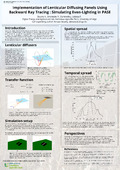
[en] Spatial and temporal light distribution plays a critical role in optimizing photosynthetic efficiency in agrivoltaic systems. Abrupt transitions between light and shade can hinder photosynthesis [1], [2], [3], reducing crop yields and affecting overall system efficiency. The use of diffusers to distribute light uniformly in even-lighting systems has shown promise [4] but requires extensive physical experimentation to evaluate their effects in diverse conditions. This study proposes a simulation-based approach within the Python Agrivoltaic Simulation Environment (PASE).
Observations from field experiments conducted using lenticular diffusing sheets with axial lenses showed that a ray of light, when diffused through such lenticular sheets, forms a conic section on the ground. The exact type of conic section depends on the diffuser configuration and the direction of the incoming sun ray. To simulate this phenomenon, we model the diffusers through a bidirectional transmittance distribution function. This transfer function describes how light rays are diffused through the material and provides the directions in which light rays are scattered when they exit the diffusers (Figure 1). Simulations based on this model show good agreement with experimental observations from real-world tests (Figure 2).
Our simulation framework offers flexibility in experimenting with different diffuser geometries, which is crucial for understanding the effects of light distribution on photosynthesis in various environments. All light simulations, including the diffusers, are based on backward ray tracing, providing efficiency in the computations. Future use include coupling with crop models to simulate the effect of even-lighting on crop yield, or with dynamic photosynthesis models [2] to simulate the effect of even-lighting on CO2 assimilation. These insights could inform the optimization of light spatio-temporal availability for crops. Further generalization of the model is needed to account for a broader range of environmental variables and diffuser materials.
Research Center/Unit :
BIODYNE - TERRA Research Centre. Biosystems Dynamics and Exchanges - ULiège
Disciplines :
Engineering, computing & technology: Multidisciplinary, general & others Energy Agriculture & agronomy
Author, co-author :
Bouvry, Arnaud ; Université de Liège - ULiège > Département GxABT > Biosystems Dynamics and Exchanges (BIODYNE)
Bruhwyler, Roxane ; Université de Liège - ULiège > TERRA Research Centre > Animal Sciences (AS) ; Université de Liège - ULiège > Département GxABT > Biosystems Dynamics and Exchanges (BIODYNE)
Dartevelle, Joran ; Université de Liège - ULiège > TERRA Research Centre > Biosystems Dynamics and Exchanges (BIODYNE)
Lebeau, Frédéric ; Université de Liège - ULiège > Département GxABT > Biosystems Dynamics and Exchanges (BIODYNE)
Language :
English
Title :
Implementation of Lenticular Diffusing Panels Using Backward Ray Tracing