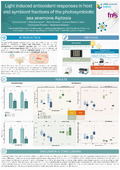
[en] Coral reefs are among the most productive and biologically diverse ecosystems on Earth. The ecological success of reef-building corals in tropical oligotrophic waters relies on the symbiosis between scleractinian corals and photosynthetic dinoflagellates of the family Symbiodiniaceae. In this mutualistic relationship, the symbionts provide photosynthetic products (glycerol, glucose, amino acids, and lipids) to the host. Conversely, the host ensures protection for the symbionts and provides nutrients essential for photosynthesis. However, despite the benefits associated with symbiosis, hosting intracellular photosynthetic organisms may induce local hyperoxia within both host and symbiont tissues, and promote the generation of reactive oxygen species (ROS).
In this study, we examined the antioxidant responses of the host and algal fractions of the model sea anemone Exaiptasia diaphana exposed to low and high light intensities (20 vs. 500 µmol photons m-2 s-1) for 24 and 72 h. Photosynthetic performance was assessed, and antioxidant capacity was quantified using the ORAC (Oxygen Radical Absorbance Capacity) assay and the activity of key antioxidant enzymes (e.g. SOD, catalase). Our results show that high light induced a significant decline in photosynthetic efficiency compared to low light, with Fv/Fm decreasing from 0.6 to 0.2. Antioxidant responses showed distinct patterns in host and algal fractions depending on light intensity and exposure duration. For instance, after 72 h of exposure, ORAC values in the F003 strain increased by more than 30% in both algal and host fractions. By providing a more comprehensive characterization of antioxidant profiles in both partners, this study provides new insights into redox homeostasis and its role in the regulation of cnidarian-algal symbiosis.
Disciplines :
Aquatic sciences & oceanology
Author, co-author :
Carnac, Enora ; Université de Liège - ULiège > Département de Biologie, Ecologie et Evolution > Ecophysiologie et physiologie animale
Branquart, May ; Université de Liège - ULiège > Faculté des Sciences > Master biol. orga. & écol., fin. approf.