Abstract :
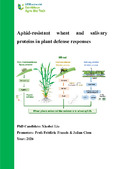
[en] Management of wheat aphids mainly relies on chemical insecticides, which has led to increasing concerns regarding pesticide residues and resistance, environmental polution. Therefore, the development and cultivation of aphid-resistant wheat varieties are widely recognized as an effective- and sustainable- approach for aphid control and alternative measure to reduce over-reliance on chemical control. However, the poorly understanding of the mechanisms of wheat-aphid interactions has hindered aphid-resistant wheat breeding and application in agriculture. In this study, the mechanisms regulating wheat-aphid interactions were investigated from three aspects: 1) non-host resistance, 2) the aphid-resistant mechanisms of hexaploid wheat varieties, and 3) wheat immune response induced by aphid salivary proteins.
Firstly, using aphid bioassays and feeding behavior detection (electrical penetration graph, EPG), we used wheat seedling as a host for wheat aphid (Sitobion avenae), a poor-host for green peach aphid (Myzus persicae) and a non-host for pea aphid (Acyrthosiphon pisum), to establish a workflow for investigating aphid-induced poor-host resistant mechanisms. Compared with S. avenae, wheat plant pre-infested by M. persicae significantly suppressed the reproduction of aphid nymphs. Based on comparative transcriptomic analysis, M. persicae pre-infestation preferentially induced the expression of genes involved in α-linolenic acid metabolism, suggesting a prominent role for jasmonic acid (JA)-mediated defense responses during poor-host interactions. Also, M. persicae feeding, but not S. avenae, triggered a significant accumulation of endogenous JA in wheat plant. Furthermore, a Bowman-Birk trypsin inhibitor of wheat, designated as TaBBTI-1, was strongly induced by M. persicae infestation and was further upregulated by exogenous JA application. Moreover, artificial diets supplemented with recombinant TaBBTI-1 protein and overexpressing TaBBTI-1 in wheat significantly impaired the fecundity of S. avenae.
Secondly, two hexaploid wheat (Triticum aestivum) cv. Hanmai 6172 (HM6172) and cv. Nongda 399 (ND399) were identified as aphid-resistant and aphid-susceptible wheat varieties, respectively. Age-stage life table and EPG analyses indicated that cv. HM6172 with antibiosis-resistance to aphids. Also, aphid infestation preferentially activated genes associated with phenylpropanoid and flavonoid (rutin and luteolin) biosynthesis while α-linolenic acid metabolism in cv. HM6172. Moreover, aphid feeding induced a significant accumulation of JA in cv. HM6172. In addition, dietary supplementation with rutin significantly reduced the fecundity of S. avenae, Schizaphis graminum, and M. persicae. Silencing TaF3GT (UDP-glucose: flavonol 3-O-glucosyltransferase), a key gene involved in rutin biosynthesis, via virus-induced gene silencing (VIGS) significantly reduced rutin accumulation in wheat. Furthermore, the AT-hook motif nuclear-localized protein 19 (TaAHL19) directly bound to the TaF3GT promoter and activated its expression, as demonstrated by yeast one-hybrid and dual-luciferase assays. Moreover, overexpression of TaAHL19 significantly enhanced rutin accumulation and aphid resistance in wheat.
Thirdly, Sa6007, a salivary protein from S. avenae was identified as a candidate elicitor. Delivery of Sa6007 into wheat leaves using a Pseudomonas fluorescens-mediated bacterial type III secretion system induced hydrogen peroxide accumulation and callose deposition, indicating the activation of plant defense responses. Consistently, the overexpression of Sa6007 in wheat (cv. Mingxian169) enhanced both salicylic acid (SA) and JA-mediated plant defense responses and significantly reduced aphid performance. Protein-protein interaction assays further showed that Sa6007 directly interacts with the wheat transcription factor TaTIFY10b in plant nucleus.
In conclusion, this study elucidates key mechanisms underlying wheat resistance to aphids from three aspects, i.e. non-host resistance, host plant resistance, and salivary elicitor-triggered immunity. cv. HM6172 was identified as a valuable aphid-resistant wheat cultivar. TaBBTI-1 and the TaAHL19-TaF3GT-rutin modules provide promising genetic and metabolic resources for developing broad-spectrum wheat. From the aphid side, salivary elicitor Sa6007 activates wheat defense and provides a potential target for manipulating induced resistance against aphids. Importantly, results from different parts of this thesis consistently support an important role for JA-associated defense responses in wheat resistance to aphids. These findings provide both mechanistic insights and practical genetic resources for the development of durable and sustainable aphid management strategies in wheat.