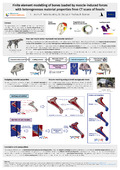
[en] Finite element modelling is increasingly used in palaeontology to investigate the biomechanics of extinct species and infer their behaviour. In this context, the open-source code fossils is used to simulate biological structures subjected to muscle-driven loads.
A key enabler of this workflow is Gmsh. The fossils code relies directly on the Gmsh C++ SDK to construct the finite element system to be solved. Beyond mesh generation, Gmsh provides fine control over mesh resolution through background mesh fields, which are used to locally refine the mesh near material interfaces. This approach allows us to limit discretization errors without explicitly modelling the interfaces.
This work extends the capabilities of fossils to support several types of materials within the same model. Applications include bite force simulations in marine reptiles and sabre-toothed cats, as well as axial compression of an elephant humerus, highlighting the importance of advanced meshing strategies for reliable biomechanical analysis.
Disciplines :
Mechanical engineering Life sciences: Multidisciplinary, general & others
Author, co-author :
Leruth, Lydia ; Université de Liège - ULiège > Faculté des Sciences Appliquées > Master ing. civ. phys., fin. approf.
Della Giustina, Francesco ; Université de Liège - ULiège > Département de géologie > Evolution and diversity dynamics lab
Chatar, Narimane ; Université de Liège - ULiège > Département de géologie > Evolution and diversity dynamics lab
Fischer, Valentin ; Université de Liège - ULiège > Département de géologie > Evolution and diversity dynamics lab
Boman, Romain ; Université de Liège - ULiège > Département d'aérospatiale et mécanique
Language :
English
Title :
Finite element modelling of bones loaded by muscle-induced forces with heterogeneous material properties from CT scans of fossils