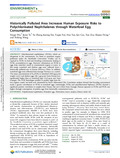
[en] Polychlorinated naphthalenes (PCNs), which are ubiquitous in the environment, are listed as persistent organic pollutants under the Stockholm Convention. Poultry can be exposed to PCNs via feed and breeding environments, leading to PCNs accumulation in eggs. However, information on PCNs in eggs from waterfowl raised in contaminated regions is scarce. In this study, waterfowl and chicken eggs were collected from a historically polluted area in Hunan Province, China. In addition, waterfowl eggs were collected from Guangxi Province as a control. The mean concentrations of Σ75PCNs in waterfowl (30.8 pg/g wet weight [ww]) and chicken eggs (26.1 pg/g ww) from Hunan were significantly higher than in waterfowl eggs (15.6 pg/g ww) from Guangxi. The PCN homologue profiles in poultry eggs from the two regions varied, but both were dominated by lower chlorinated CNs. Correlation analysis showed that breeding environment made a greater contribution to PCNs in waterfowl eggs. Interestingly, PCNs and polychlorinated biphenyls (PCBs) showed a significant positive correlation in samples from Hunan, but not in those from Guangxi. Human exposure to PCNs and PCBs was higher through consumption of poultry eggs from historically contaminated areas.
Disciplines :
Environmental sciences & ecology
Author, co-author :
Wu, Xingyi; Institute of Quality Standards and Testing Technology for Agro-Products, Chinese Academy of Agricultural Sciences, Beijing 100081, China ; College of Science, China Agricultural University, Beijing 100193, China
Yi, Jianxi; Hunan Provincial Institute of Veterinary Drugs and Feed Control, Changsha 410006, China
Zhang, Su; Institute of Quality Standards and Testing Technology for Agro-Products, Chinese Academy of Agricultural Sciences, Beijing 100081, China
Xin, Jianing; Institute of Quality Standards and Testing Technology for Agro-Products, Chinese Academy of Agricultural Sciences, Beijing 100081, China ; College of Science, China Agricultural University, Beijing 100193, China
Fan, Yaqun; Institute of Quality Standards and Testing Technology for Agro-Products, Chinese Academy of Agricultural Sciences, Beijing 100081, China
Yan, Han; Guangxi Zhuang Autonomous Region Feed Monitoring Institute, Nanning 530001, China
Cao, Jun; Institute of Quality Standards and Testing Technology for Agro-Products, Chinese Academy of Agricultural Sciences, Beijing 100081, China
Zou, Yun ; Université de Liège - ULiège > Département de chimie (sciences) > Chimie analytique, organique et biologique
Dong, Shujun ; Institute of Quality Standards and Testing Technology for Agro-Products, Chinese Academy of Agricultural Sciences, Beijing 100081, China
Wang, Peilong ; Institute of Quality Standards and Testing Technology for Agro-Products, Chinese Academy of Agricultural Sciences, Beijing 100081, China
Language :
English
Title :
Historically Polluted Area Increases Human Exposure Risks to Polychlorinated Naphthalenes through Waterfowl Egg Consumption.
This study was supported by the Central Public-interest Scientific Institution Basal Research Fund of Chinese Academy of Agricultural Sciences (1610072024003).
Klimczak, M.; Liu, G.; Kilanowicz, A.; Falandysz, J. An updated global overview of the manufacture and unintentional formation of polychlorinated naphthalenes (PCNs). J. Hazard. Mater. 2023, 457, 131786, 10.1016/j.jhazmat.2023.131786
Persistent Organic Pollutants Review Committee . The 16 New POPs, Stockholm Convention on Persistent Organic Pollutants, Geneva, 2017. https://www.pops.int/Portals/0/download.aspx?d=UNEP-POPS-PUB-Booklet-16NewPOPs-201706.English.pdf (accessed 2024-08-22).
Liu, G.; Cai, Z.; Zheng, M. Sources of unintentionally produced polychlorinated naphthalenes. Chemosphere 2014, 94, 1- 12, 10.1016/j.chemosphere.2013.09.021
Domingo, J. L.; Falco, G.; Llobet, J. M.; Casas, C.; Teixido, A.; Muller, L. Polychlorinated naphthalenes in foods: Estimated dietary intake by the population of Catalonia, Spain. Environ. Sci. Technol. 2003, 37 ( 11), 2332- 2335, 10.1021/es030009b
Fernandes, A.; Mortimer, D.; Gem, M.; Smith, F.; Rose, M.; Panton, S.; Carr, M. Polychlorinated naphthalenes (PCNs): congener specific analysis, occurrence in food, and dietary exposure in the UK. Environ. Sci. Technol. 2010, 44 ( 9), 3533- 3538, 10.1021/es903502g
Zacs, D.; Perkons, I.; Pasecnaja, E.; Bartkevics, V. Polychlorinated naphthalenes (PCNs) in food products in Latvia: Congener-specific analysis, occurrence, and dietary exposure of the general population. Chemosphere 2021, 264, 128460, 10.1016/j.chemosphere.2020.128460
Li, C.; Zhang, L.; Yang, Q.; Wu, Y.; Zheng, M.; Yang, L.; Lyu, B.; Liu, X.; Jin, R.; Sun, Y.; Chen, C.; Yang, Y.; Qin, L.; Lin, B.; Li, D.; Li, J.; Liu, G. Comprehensive evaluation of dietary exposure and health risk of polychlorinated naphthalenes. Environ. Sci. Technol. 2022, 56 ( 9), 5520- 5529, 10.1021/acs.est.1c08614
Godere, M.; Cariou, R.; Padioleau, A.; Venisseau, A.; Marchand, P.; Brosseau, A.; Vaccher, V.; Le Bizec, B.; Dervilly, G. Polychlorinated naphthalenes in foods from the French market: Occurrence, dietary exposure, and evaluation of relative contributions to dioxin-like contaminants. Environ. Sci. Technol. 2024, 58 ( 3), 1721- 1730, 10.1021/acs.est.3c07838
Pirard, C.; De Pauw, E. Uptake of polychlorodibenzo-p-dioxins, polychlorodibenzofurans and coplanar polychlorobiphenyls in chickens. Environ. Inter. 2005, 31 ( 4), 585- 591, 10.1016/j.envint.2004.10.008
Wang, C.; Dong, S.; Wang, P.; Hao, Y.; Wang, R.; Zhang, S.; Wang, Y.; Wang, P.; Zhang, Q.; Jiang, G. A pilot evaluation on the toxicokinetics and bioaccumulation of polychlorinated naphthalenes in laying hens. Sci. Total Environ. 2022, 835, 155454, 10.1016/j.scitotenv.2022.155454
Sanger, V. L.; Scott, L.; Hamdy, A.; Gale, C.; Pounden, W. D. Alimentary toxemia in chickens. J. Am. Vet. Med. Assoc. 1958, 133 ( 3), 172- 176
Lee, W.-J.; Shih, S.-I.; Li, H.-W.; Lin, L.-F.; Yu, K.-M.; Lu, K.; Wang, L.-C.; Chang-Chien, G.-P.; Fang, K.; Lin, M. Assessment of polychlorinated dibenzo-p-dioxins and dibenzofurans contribution from different media to surrounding duck farms. J. Hazard. Mater. 2009, 163 ( 2-3), 1185- 1193, 10.1016/j.jhazmat.2008.07.079
El Sabry, M. I.; Almasri, O. Global waterfowl production: stocking rate is a key factor for improving productivity and well-being-a review. Trop. Anim. Health Pro. 2023, 55 ( 6), 419, 10.1007/s11250-023-03835-6
Hoogenboom, R. L. A. P.; ten Dam, G.; van Bruggen, M.; Jeurissen, S. M. F.; van Leeuwen, S. P. J.; Theelen, R. M. C.; Zeilmaker, M. J. Polychlorinated dibenzo-p-dioxins and dibenzofurans (PCDD/Fs) and biphenyls (PCBs) in home-produced eggs. Chemosphere 2016, 150, 311- 319, 10.1016/j.chemosphere.2016.02.034
Yang, L.; Zheng, M.; Zhu, Q.; Yang, Y.; Li, C.; Liu, G. Inventory of Polychlorinated Naphthalene Emissions from Waste Incineration and Metallurgical Sources in China. Environ. Sci. Technol. 2020, 54 ( 2), 842- 850, 10.1021/acs.est.9b05539
Dong, S.; Zhang, S.; Zou, Y.; Li, T.; Wang, R.; Wang, Y.; Zhao, Y.; Cheng, J.; Wu, G.; Wang, P. Pilot study on the effect of secondary copper smelters on polychlorinated naphthalene contamination in surrounding agricultural areas. Sci. Total Environ. 2022, 852, 158223, 10.1016/j.scitotenv.2022.158223
Gao, L.; Zhang, Q.; Zhang, B.; Liu, W.; Xiao, K. Polychlorinated dibenzo-p-dioxins and dibenzofurans in water and six fish species from Dongting Lake, China. Chemosphere 2014, 114, 150- 157, 10.1016/j.chemosphere.2014.04.015
Huang, Z.; Zheng, B.; Yin, D.; Cui, T.; Zhao, X. Distribution characteristics and risk assessment of 209 polychlorinated biphenyls in Dongting Lake and the inflow rivers. Huan jing ke xue 2022, 43 ( 1), 363- 368, 10.13227/j.hjkx.202106061
Chinese Standard. The Technical Specification for soil Environmental monitoring. HJ/T 166-2004. The environmental protection industry standards of the People’s Republic of China, 2004. (in Chinese).
Chinese Standard.. Feeding Stuffs-sampling. GB 14699-2023. The National Standards of People’s Republic of China, 2023. (in Chinese).
Dong, S.; Li, J.; Zheng, B.; Zhang, L.; Zhang, S.; Zou, Y.; Wang, Y.; Fan, M.; Wang, R.; Li, Y.; Wu, Y.; Su, X.; Wang, P. Occurrence and source analysis of polychlorinated naphthalenes in raw cow milk. Food Chem. 2022, 381, 132247, 10.1016/j.foodchem.2022.132247
Martí-Cid, R.; Llobet, J. M.; Castell, V.; Domingo, J. L. Human exposure to polychlorinated naphthalenes and polychlorinated diphenyl ethers from foods in Catalonia, Spain: temporal trend. Environ. Sci. Technol. 2008, 42 ( 11), 4195- 4201, 10.1021/es800064p
Fernandes, A. R.; Tlustos, C.; Rose, M.; Smith, F.; Carr, M.; Panton, S. Polychlorinated naphthalenes (PCNs) in Irish foods: Occurrence and human dietary exposure. Chemosphere 2011, 85 ( 3), 322- 328, 10.1016/j.chemosphere.2011.06.093
Dong, S.; Zhang, S.; Wu, X.; Cao, J.; Yan, M.; Zou, Y.; Yan, H.; Tang, J.; Suo, D.; Wang, P. A preliminary study on short- and medium-chain chlorinated paraffins in duck farms: Concentrations, distribution, and dietary exposure risks. Environ. Res. 2024, 246, 118109, 10.1016/j.envres.2024.118109
Wang, Y.; Zhang, S.; Fan, M.; Wang, R.; Zou, Y.; Wang, P.; Cheng, J.; Dong, S. Polychlorinated naphthalenes in farmed Chinese mitten crabs in China: concentration, distribution and source analysis. Environ. Res. 2022, 206, 112582, 10.1016/j.envres.2021.112582
Dong, S.; Zhang, S.; Li, T.; Zou, Y.; Cheng, J.; Wang, P. Occurrence of polychlorinated naphthalenes in dairy cow farms in proximity to an iron smelting plant in China: A preliminary study. Environ. Res. 2022, 215, 114361, 10.1016/j.envres.2022.114361
Lin, B.; Yang, Y.; Yang, L.; Liu, G.; Li, C.; Xu, J.; Hou, S.; Zheng, M. Congener profiles and process distributions of polychlorinated biphenyls, polychlorinated naphthalenes and chlorinated polycyclic aromatic hydrocarbons from secondary copper smelting. J. Hazard. Mater. 2022, 423, 127125, 10.1016/j.jhazmat.2021.127125
Falandysz, J.; Fernandes, A.; Gregoraszczuk, E.; Rose, M. The toxicological effects of halogenated naphthalenes: a review of aryl hydrocarbon receptor-mediated (dioxin-like) relative potency factors. J. Environ. Sci. Health C Environ. Carcinog. Ecotoxicol. Rev. 2014, 32 ( 3), 239- 272, 10.1080/10590501.2014.938945
DeVito, M.; Bokkers, B.; van Duursen, M. B. M.; van Ede, K.; Feeley, M.; Gáspár, E. A. F.; Haws, L.; Kennedy, S.; Peterson, R. E.; Hoogenboom, R.; Nohara, K.; Petersen, K.; Rider, C.; Rose, M.; Safe, S.; Schrenk, D.; Wheeler, M. W.; Wikoff, D. S.; Zhao, B.; vas den Berg, M. The 2022 world health organization reevaluation of human and mammalian toxic equivalency factor for polychlorinated dioxins, dibenzofurans, and biphenlys. Regul. Toxicol. Pharmacol. 2024, 146, 105525, 10.1016/j.yrtph.2023.105525
Chinese Nutrition Society. Chinese Dietary Guidelines 2022. People’s Medical Publishing House. Beijing, China, 2022. (in Chinese).
Knutsen, H. K.; Alexander, J.; Barregard, L.; Bignami, M.; Bruschweiler, B.; Ceccatelli, S.; Cottrill, B.; Dinovi, M.; Edler, L.; Grasl-Kraupp, B.; Hogstrand, C.; Nebbia, C. S.; Oswald, I. P.; Petersen, A.; Rose, M.; Roudot, A.-C.; Schwerdtle, T.; Vleminckx, C.; Vollmer, G.; Wallace, H.; Furst, P.; Hakansson, H.; Halldorsson, T.; Lundebye, A.-K.; Pohjanvirta, R.; Rylander, L.; Smith, A.; Van Loveren, H.; Waalkens-Berendsen, I.; Zeilmaker, M.; Binaglia, M.; Ruiz, J. A. G.; Horvath, Z.; Christoph, E.; Ciccolallo, L.; Bordajandi, L. R.; Steinkeliner, H.; Hoogenboom, L.; Chain, E. P. C. F. Risk for animal and human health related to the presence of dioxins and dioxin-like PCBs in feed and food. EFSA J. 2018, 16 ( 11), 5333, 10.2903/j.efsa.2018.5333
EFSA Panel name on Contaminants in the Food Chain (CONTAM); Schrenk, D.; Bignami, M.; Bodin, L.; Chipman, J. K.; del Mazo, J.; Grasl-Kraupp, B.; Hogstrand, C.; Hoogenboom, L. R.; Leblanc, J.-C.; Nebbia, C. S.; Ntzani, E.; Petersen, A.; Sand, S.; Schwerdtle, T.; Vleminckx, C.; Wallace, H.; Falandysz, J.; Hart, A.; Rose, M.; Anastassiadou, M.; Eskes, C.; Gergelova, P.; Innocenti, M.; Rovesti, E.; Whitty, B.; Nielsen, E. Risks for animal and human health related to the presence of polychlorinated naphthalenes (PCNs) in feed and food. EFSA J. 2024, 22 ( 3), e8640 10.2903/j.efsa.2024.8640