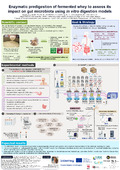
Abstract :
[en] Whey, a by-product of cheese production, accounts for around 50 million m³ annually in the European Union, yet remains partly underutilized, raising environmental concerns within the dairy sector (Rao et al., 2021). Previous studies have shown that whey-derived proteins and fermented dairy components can modulate gut microbiota composition and support intestinal health (Ashaolu et al., 2026; Smith et al., 2020). This evidence highlights whey as a promising substrate for the development of sustainable, value-added food products. In addition, whey-derived substrates may reach the colon, where they interact with the gut microbiota and are metabolized into bioactive compounds, including short-chain fatty acids, influencing intestinal health and microbial activity. Nevertheless, studying these microbiota-driven effects remains challenging, as digestion and absorption processes in the upper gastrointestinal tract must be accurately simulated to determine the fraction reaching the colon.
This study aims to evaluate the enzymatic predigestion and absorption of whey prior to assessing its impact on the intestinal microbiota.
Since whey proteins and lactose are primarily digested and absorbed in the proximal gastrointestinal tract, it is essential to characterize these processes before investigating colonic effects. A simulation of the upper gastrointestinal tract will be carried out using the INFOGEST 2.0 protocol (Brodkorb et al., 2019; Minekus et al., 2014). The outcome will be a predigested whey-based product suitable for inoculation into more complex in vitro fermentation models such as the SHIME system (Goya-Jorge et al., 2024). Preliminary analyses will focus on changes in whey composition before and after in vitro digestion, including protein structure, lactose availability, and macronutrient distribution, to characterize the fraction available for microbial fermentation.
This work is currently in progress. Preliminary efforts focus on optimizing enzyme concentrations and digestion conditions during gastric and ileal phases.
This approach is expected to improve understanding of how whey-derived compounds influence microbiota-driven responses, supporting the development of sustainable, value-added dairy products with potential benefits for intestinal health.
This research is part of the ALAFERM project, an Interreg Greater Region initiative co-funded by the European Union, addressing the valorization of agri-food by-products and the sustainability of the dairy sector.