Keywords :
Rice, Rice blast, Receptor-like cytoplasmic kinases (RLCKs), With No-lysine Kinase, WRKY transcription factor
Abstract :
[en] Rice blast disease, caused by Magnaporthe oryzae, represents one of the most destructive diseases affecting rice production worldwide and poses a major threat to global food security. Improving our understanding of the molecular mechanisms underlying rice immunity is therefore essential for the development of durable disease-resistant varieties.
Receptor-like cytoplasmic kinases (RLCKs) have emerged as key regulators of plant immune signaling. Among them, OsRLCK109 was previously identified as a negative regulator of rice blast resistance; however, the molecular mechanisms by which it modulates immune responses remained largely unknown. The objective of this thesis was to elucidate the regulatory network controlled by OsRLCK109 through the identification and functional characterization of its interacting partners.
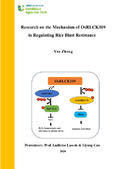
Using a combination of protein–protein interaction assays, biochemical analyses, gene expression studies, and functional characterization of mutant lines, we identified two major regulatory pathways mediated by OsRLCK109.
First, we demonstrate that OsWNK1 interacts with OsRLCK109 and plays a dual role in regulating both biotic and abiotic stress responses. OsWNK1 directly phosphorylates the catalase OsCATA, thereby modulating its enzymatic activity and regulating reactive oxygen species (ROS) homeostasis. This mechanism promotes ROS accumulation during pathogen infection, enhancing immune signaling and resistance to rice blast. Conversely, under abiotic stress conditions, reduced catalase activity impairs ROS scavenging, leading to increased oxidative damage and decreased tolerance to drought and cold stress. These results reveal a key role for the OsRLCK109–OsWNK1–OsCATA module in balancing immunity and stress adaptation.
Second, we identify the transcription factor OsWRKY76 as another interacting partner of OsRLCK109. We show that OsRLCK109 phosphorylates OsWRKY76 and enhances its ability to repress the transcription of the defense-related gene PR1b. Functional analyses indicate that OsWRKY76 acts as a negative regulator of rice blast resistance, and that OsRLCK109 reinforces this inhibitory effect. These findings uncover a novel regulatory pathway in which OsRLCK109 modulates immune responses through transcriptional control.
Taken together, this work demonstrates that OsRLCK109 acts as a central regulatory node integrating ROS-mediated signaling and transcriptional repression to fine-tune rice immune responses. By linking disease resistance with abiotic stress tolerance, this study provides new insights into the complex trade-offs governing plant adaptation. These findings also offer valuable molecular targets and genetic resources for the development of rice varieties with improved resistance to biotic and abiotic stresses.