Abstract :
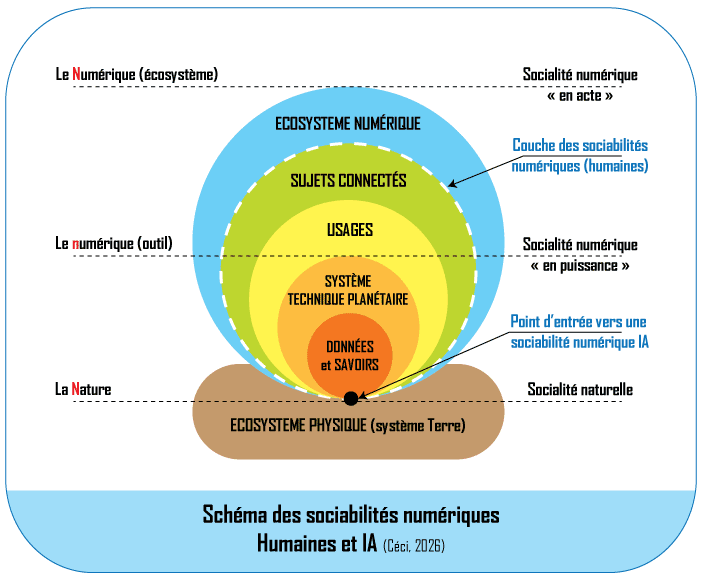
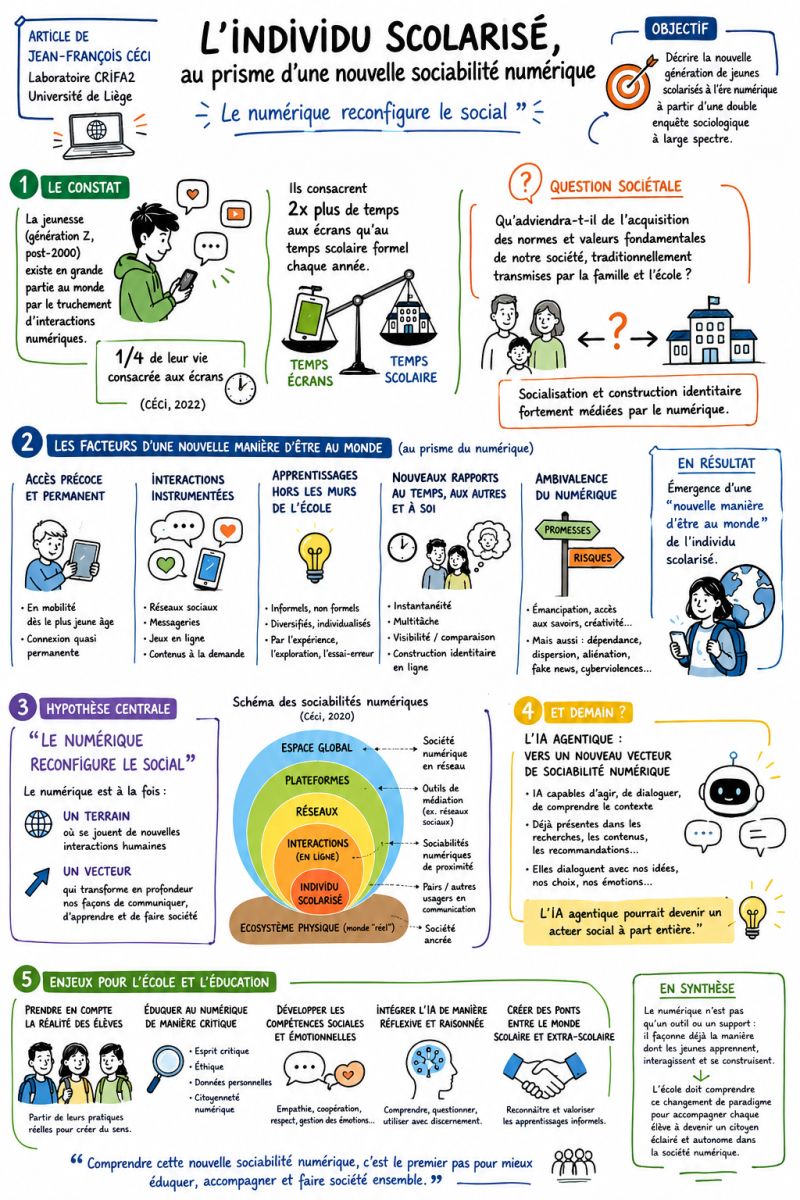
[fr] Cet article vise à caractériser une nouvelle génération de jeunes scolarisés à l’ère numérique, à partir notamment d’une double enquête sociologique à large spectre. La jeunesse actuelle (génération Z, post 2000) existe en grande partie au monde par le truchement d’interactions numériques, consacrant un quart de sa vie aux écrans (Céci, 2022, p. 2). Ces interactions instrumentées génèrent également des apprentissages hors les murs de l’école, où les jeunes consacrent deux fois plus de temps aux écrans qu’au temps scolaire formel chaque année ; cette asymétrie n’est pas sans incidence sur la socialisation et la construction identitaire. Qu’adviendra-t-il alors de l’acquisition des normes et valeurs fondamentales de notre société, traditionnellement transmises par la famille et l’école ? Nos résultats permettent d’esquisser l’émergence d’une « nouvelle manière d’être au monde » chez l’individu scolarisé, forgée par de multiples facteurs que nous analyserons au prisme du numérique. Ce dernier apparaît ainsi comme terrain et vecteur principal d’une nouvelle sociabilité, nous amenant à formuler l’hypothèse suivante : « le numérique reconfigure le social ». Le terrain scolaire permet d’illustrer et de caractériser cette « sociabilité numérique », enrichi par une réflexion prospective sur l’intégration de l’IA agentique en tant que vecteur de sociabilité numérique.
[en] This article aims to characterize a new generation of young people educated in the digital age, drawing primarily on a broad-spectrum, two-pronged sociological survey. Today's youth (Generation Z, post-2000) largely experience the world through digital interactions, devoting a quarter of their lives to screens (Céci, 2022, p. 2). These technology-mediated interactions also generate learning outside the school setting, where young people spend twice as much time on screens as in formal schooling each year; this asymmetry has significant implications for socialization and identity formation. What will become of the acquisition of the fundamental norms and values of our society, traditionally transmitted by family and school? Our findings allow us to outline the emergence of a "new way of being in the world" among the educated individual, shaped by multiple factors that we will analyze through the lens of digital technology. The latter thus appears as the primary terrain and vector of a new sociability, leading us to formulate the following hypothesis: "digital technology reconfigures the social." The school setting allows us to illustrate and characterize this "digital sociability," enriched by a forward-looking reflection on the integration of agentic AI as a vector of digital sociability.