Abstract :
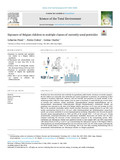
[en] Pesticides have been extensively used worldwide for agricultural, public health, veterinary or domestic purposes. Because children are among the most vulnerable and exposed populations to pesticides, the monitoring of their exposure is of primary importance. However, only few currently used pesticides are usually included in biomonitoring studies, while for a large number, data are sparse or inexistant. To partly fill this gap, several classes of currently used pesticides, namely pyrethroids, organophosphorus (through dialkylphosphates and trichloropyridinol), neonicotinoids, dithiocarbamates (through ethylenethiourea), chlormequat chloride and glyphosate were measured in the urine of 84 Belgian children aged from 2 to 15 years and recruited in 2019. Most of the pyrethroid metabolites studied showed detection frequencies ranging between 63 and 99% with median concentrations from 0.36 to 1.54 μg/L, while trichloropyridinol and diethylphosphate (respectively specific and common metabolite to several organophosphorus including chlorpyrifos) were the most frequently measured among organophosphorus in 100% and 98% of the samples (P50 = 1.25 and 1.83 μg/L). Among neonicotinoids, acetamiprid desmethyl and imidacloprid metabolites (hydroxyled and olefin) were the most abundant confirming the relevance of their measurement compared to the corresponding parents. Ethylenethiourea and chlormequat chloride were positively detected in most samples (68% and 100% respectively) with median levels of 0.40 μg/L and 6.7 μg/L demonstrating the widespread exposure of the Belgian children, while glyphosate and aminomethylphosphonic acid were detected in 25% and 19% of the samples confirming the low levels usually found in urine. To our knowledge, this is the first study reporting biomonitoring data of neonicotinoid, ethylenethiourea and chlormequat chloride in a Belgian population.
Scopus citations®
without self-citations
0