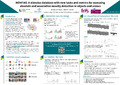
[en] The ability to detect novelty is crucial for survival, yet it is complex. To capture this complexity, researchers distinguish between different types of novelty, as neuroscientific evidence shows that distinct brain circuits process novelty depending on its nature. Absolute novelty refers to stimuli that are entirely unfamiliar to the observer and is thought to rely on the perirhinal cortex, whereas associative novelty arises from unfamiliar combinations of familiar elements and is presumably detected by the hippocampus. Despite this distinction, methodological tools specifically designed to investigate different forms of novelty remain scarce. Moreover, given that the perirhinal cortex supports object processing and the hippocampus scene processing, it remains unclear how novelty is detected across representational levels. To address this gap, we developed the NOVITAS database, enabling direct and systematic comparison of absolute and associative novelty for objects and scenes within the same experimental tasks. We provide a large database of stimuli that assess novelty detection without prior lab exposure, relying solely on pre-existing knowledge. To do so, stimulus novelty was validated in a normative online study with younger (N = 104) and older adults (N = 184). We then substantially adapted classic novelty-detection tasks—an Oddball-like paradigm (N = 24) and a modified Visual Paired Comparison task (N = 76)—and validated that our stimuli elicit behavioral and eye-tracking novelty markers in young adults. Results confirmed that participants looked longer at novel than familiar images, but the time course of novelty preference differed across conditions, suggesting that the stimuli can probe different underlying mechanisms.
Disciplines :
Theoretical & cognitive psychology
Author, co-author :
Servais, Anaïs ; Université de Liège - ULiège > Département de Psychologie
NOVITAS: A stimulus database with new tasks and metrics for assessing absolute and associative novelty detection in objects and scenes.
Publication date :
March 2026
Event name :
Cognitive Neuroscience Society (CNS)
Event place :
Vancouver, Canada
Event date :
7th March - 10th March
Audience :
International
Peer review/Selection committee :
Editorial reviewed
European Projects :
HE - 101147064 - DENOVO - Towards an Integrative Model of the Relationship Between Episodic Memory and Novelty Detection Through a Behavioural and Neuropsychological Approach
Funders :
European Union
Funding number :
GAP-101147064
Funding text :
Marie Skłodowska-Curie Actions (MSCA) Postdoctoral Fellowship