Keywords :
Bourdieu, Phenomenology, pragmatism, critique, sociology
Abstract :
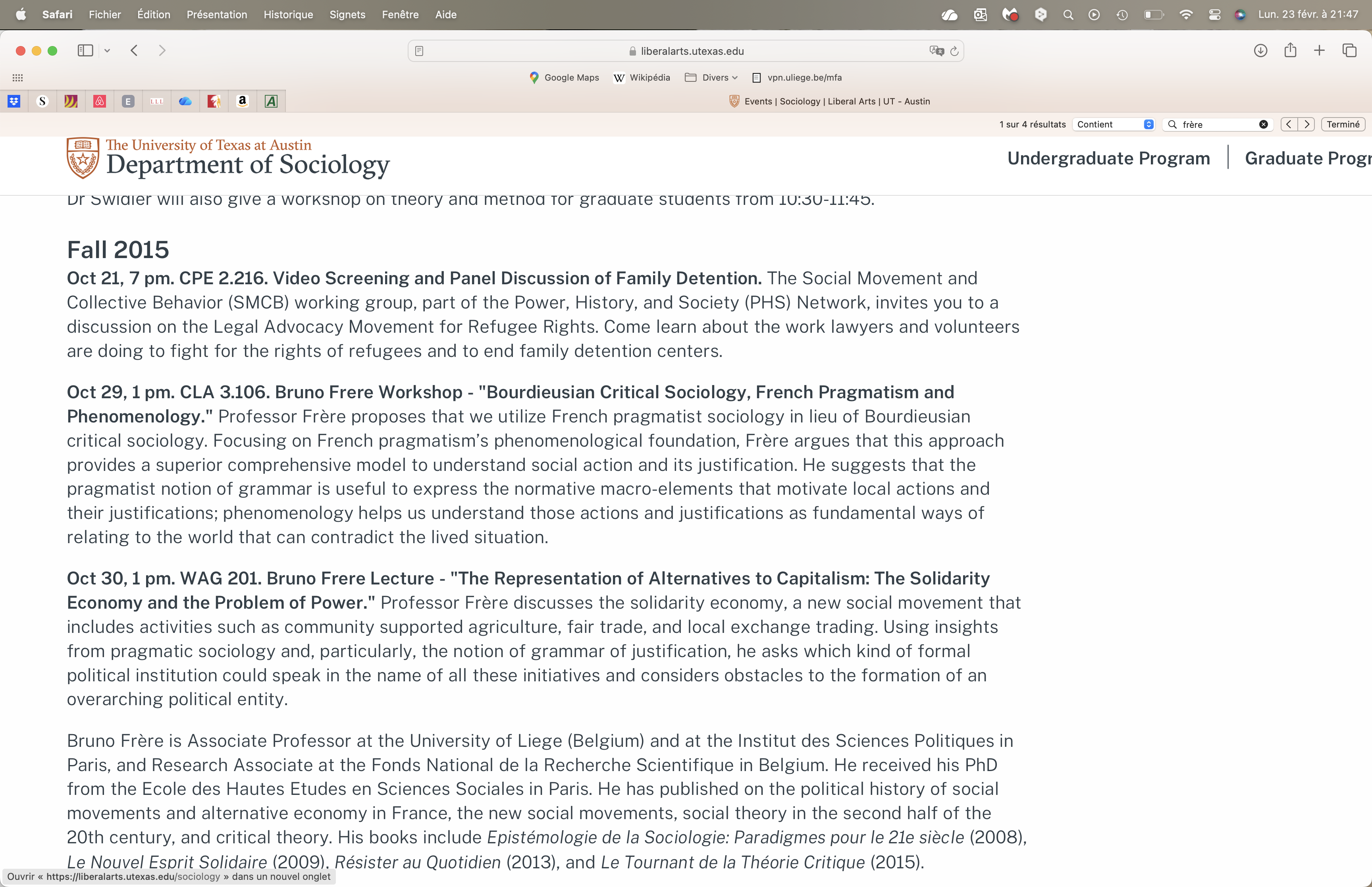
[en] This theoretical presentation is concerned with finding adequate ways of making sense of new forms of resistance to domination such as those embodied by the Indignados, Anonymous, Femen, the practitioners of “solidarity economy”, movements of unemployed people or illegals. As scholar steeped in French social theory, I’m particularly interested in the ability of specific theoretical currents to account for these forms of contestation and their potential for emancipation from alienating forces.
By the past, I used to work with the Bourdieu’s genetic and structural frame. But once I was on the field of “solidarity economy” in France (micro-finance, community-supported agriculture, etc.) in France, I was confronted to this very point; I couldn’t speak about theses ‘anti-capitalist’ cooperatives with Bourdieu because the frame of his theory of domination and his main concepts (common sense, habitus, symbolic violence, etc.) didn’t fit with the high level of reflexivity of these activists. Boltanski, my director of studies, was agreeing that it was not possible to study this kind of actors with the sociology of Bourdieu (his own Professor in the 60th) because he does not take actors “seriously”.
Bourdieu rests on the assumption that capitalism or modernity has robbed social actors of their original purity and of the consciousness of their dominated condition. The work of the sociologist is to reveal the real theoretical causes of their action they ignore because they are deeply immersed in their “illusio” or “practical sense”. During a long time Bourdieu argues that social actors are not equipped to identify and critique their alienation, and he positions sociology as the discipline which will save social actors from the alienation of their habitus.
Boltanski and I would argue that there are problems with all this approach: It assumes a pristine state of nature and unspoilt humans, all of which predate the social; ii. The alienated is unable to resist his/her condition by her/himself (Bourdieu) iii. Thus resistance would entail a return to unmediated subjectivity and sociality, only accessible for the sociologist. This stance is idealist in some way (sociologist take the point of view of god). And this idealism is unsatisfactory. It cannot account for the new forms of social resistance to domination which we identified above they know by themself how much we are dominated by social fields, notably by the capitalist frame of the economic field. Thus we need an alternative approach. In this talk I explore the potential for such an approach.
After a section dedicated to the discussion about Bourdieu, I focus on the analysis of Boltanski’s pragmatic sociology who aims, as he says, “to take people’s argumentations seriously”. This pragmatic sociology allows us to find the “grammar” of the justifications used by activists to critique capitalism and to try to build an other kind of economy. But in a third section, I will see that pragmatic sociology does not solve a last paradox: sometimes actors’ justifications are in contradiction with their practices. That’s why I completed French boltanskian pragmatism with phenomenology: actors can have contradictory behaviours, regarding justification. This does not mean that they are in the “illusio” (Bourdieu) of what they really do. This just means that they have to adapt their activities to the reality of the economy that is still a market economy with capitalist rules. Adapting their actions, they also know how much they look as “traitors”, betraying some crucial values of solidarity economy.
As a conclusion I show why we still have to consider Bourdieu as one of the most important sociologists of the 20th century. We indeed need him in this time of “managerial domination” that works as if there were no social classes anymore. We must be aware of how we are dominated by all social structures, including structures of capitalism. But we also have to still aware to these paradigms, as French pragmatic sociology or phenomenology, which aim to find cleverness within the discourse of social actors themselves to help them to rationalise and galvanize their critics.