Abstract :
[en] In our daily life, we experience an immensely rich flow of information that we segment into meaningful events. However, our memory is limited and cannot store all these perceptual information. To enable efficient remembering, our cognitive system must compress the temporal duration and the visuo-spatial details of an event into its gist. A schema representation can then emerge from the statistical regularities encountered between similar events (Sekeres et al., 2018). Although the transition from episodic, context-specific memory to abstract conceptualisation is well established, the impact of these schemas on the creation and retrieval of memories remain unclear.
Recent studies indicate that the contextual familiarity an event takes place in can influence the perceived duration and precision of our memories (Bonasia et al., 2016; Jafarpour & Spiers, 2017). Resource-based theories (Bellana et al., 2021) and construct-based hypotheses of memory (Robin & Moscovitch, 2014) assume that established representations in memory should release resources to be allocated for the encoding of new episodic details while accelerating the recall of the episode. On the other hand, schema-based theories suggest only a robust encoding for the central elements of a scene with a reduced memory for idiosyncratic details (Gilboa & Marlatte, 2017).
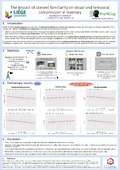
Our experiment challenges these hypotheses in an ecological setting by testing the episodic memory of first-year students on their recorded campus tour. At the first session, participants took a walk on the campus during which they crossed familiar and unfamiliar places. Then, they were asked to return to the lab to be tested on their memory of the tour. First, we measured the duration they took to mentally relive each segment of their walk as precisely as possible. Then, we asked them to describe orally the content of their mental replay. After that, they went through a forced-choice recognition task where they had to pick images of their tour rather than the ones from other participants. Finally, they had to assign a rating of familiarity to each recalled segment.
We will present preliminary data testing the aforementioned theories, with the prediction that participants will produce more detailed report, better recognition accuracy and shorter replay duration for segments experienced in a familiar place compared to in a less familiar one. Indeed, we expect robust contextual schemas to act as foundations for the creation and recall of the new episodic memories.