Abstract :
[en] Aims. Variations in the practice of elaborative parental reminiscing—i.e., when parents discuss the past with their child in a rich and collaborative manner—are known to influence children’s memory performance. In recent years, researchers have attempted to identify the specific components of reminiscing (e.g., concretization, evaluation, metacognitive talk, etc.) that contribute to this effect, with varying degrees of success as findings appear to differ depending on factors such as the type of memory task (e.g., episodic vs. autobiographical memory tasks), the nature of the events discussed (e.g., standardized vs. freely selected past events), and the timing of reminiscing (immediate vs. delayed). Here, we propose that parental reminiscing style is a flexible mechanism that varies based on the parent’s goal when they discuss the past with their child, which may explain why different types of reminiscing do not uniformly affect memory processes.
Method. To test this hypothesis, we recruited 128 parent-child dyads (Mean AgeChild = 34.37 months, SD = 6.13) and asked them to discuss three different events: (a) a past shared event freely selected by the parent, (b) a standardized shared staged activity occurring in the lab, and (c) a standardized shared staged activity occurring at home. The timing of reminiscing for the two standardized events was also manipulated: half of our parent-child dyads discussed the lab event immediately and the home event after a delay, while the other half of our sample did the reverse. After each discussion, parents completed a short questionnaire asking about their goal during the conversation (e.g., helping their child remember, regulating their emotions, etc.). Children’s memory was then assessed using an associative episodic memory task and a task evaluating memory for past events.
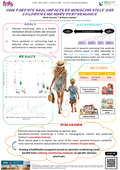
Results. Data revealed that parents’ goals during reminiscing influence their conversational style. Parents who aimed to support their child’s memory used more evaluation and metacognitive talk, whereas those focused on helping their child make sense of the event used more concretization and external references. Interestingly, while the frequency of parents’ metacognitive talk was positively associated with children’s performance on the associative memory task, children’s memory for past events was only predicted by the frequency of parental concretization and external references during the reminiscing.
Discussion & Conclusions. From a clinical perspective, our findings are critical as they could help refine existing cognitive rehabilitation programs based on parental reminiscing. Such programs have recently been proposed to support children at risk of difficulties in recalling past experiences and could benefit from tailoring reminiscing strategies to specific memory processes.