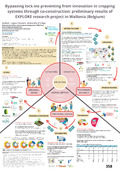
Abstract :
[en] Prospectives studies enable us to envision possible and desirable futures. They are particularly used in agroecological transition and sustainable food regime studies. To name a few, the Ten Years For Agroecology (TYFA) model demonstrate how Europe can be food self-sufficient without using pesticides and artificial fertilizers (Poux & Aubert, 2018), the Afterres2050 scenario suggests ways for the French food system transition (Couturier et al., 2016), and, more recently, still in France, the TRANSFood project is focusing on food regimes’ transition at the individual scale (Kesse-Guyot, 2021).
In Wallonia (Belgium), public authorities support food systems transition through several strategies and policies. On one hand, the referential for sustainable food systems published in 2018 had led to the Manger Demain strategy (2019) as well as Food Wallonia action plan (2019). On the other hand, the TERRAÉ platform has been created in 2022 to build an agroecological transition referential and execute an ambitious action plan. Despite these local policies and prospective studies’ demonstrations, we collectively struggle to engage in agroecological transition for sustainable food diet, at global, local and individual scales. Indeed, several lock-ins for food systems’ transition have been identified in numerous agricultural sectors, and have been well documented in the Belgian and Walloon contexts (Baret et al., 2013; De Herde et al., 2019; Lauvie & Stassart, 2016).
Started in late 2023, the EXPLoring innovative crOpping management for sustainable futuRE-proof food systems (EXPLORE) project, aims to design innovative agro-ecological cropping systems targeting sustainable and healthy dietary regimes in Wallonia. To do so, the project lean on three complementary work packages willing to:
- Work with stakeholders to redesign cropping systems and identify potential lock-ins and ways to overcome them (WP1);
- Mathematically simulate the desired innovative cropping systems and assess their different yields and trade-offs in terms of environmental impacts in the face of present-day and future climatic conditions (WP2);
- Investigate how agroecological levers empower regulation mechanisms for pests and weeds (WP3).
Gathering a research team of agronomists, economists and sociologists, the EXPLORE project relies on an interdisciplinary and co-constructive approach. EXPLORE WP1's main research question asks how co-constructed prospectives scenarios focusing on cropping systems can foster changes in food systems at larger scales. We will particularly analyze lock-ins preventing supply and demand from matching at local and regional scales, as well as tensions occurring between these scales (field, farm, territory and region).
The first step of the WP1 rely on the solicitations of several networks to identify existing initiatives and evaluate stakeholders’ interests in working on crop system diversification and food chain resettlement (i.e Food Policy Councils, Farmers working group, Local Action Groups, etc.). Depending on previous results, we will construct specific arenas where stakeholders will be invited to build prospective scenarios bypassing lock-ins preventing innovation in cropping systems. Complementarily with WP2 (modelling), these scenarios’ abilities to match local production and demand as well as minimizing agriculture environmental impacts will be evaluated and results will guide arenas’ discussions.
In the end, this presentation will discuss EXPLORE WP1 provisional results about (1) arenas constitutions regarding existing initiatives in Wallonia and (2) lock-ins identified as key topics to address in these arenas. The results will rely on literature review, semi-structured interviews with food system stakeholders as well as two preliminary workshops organized with researchers between April and July 2024.