Keywords :
Urban Agriculture, Innovation, Sustainability, Challenges
Abstract :
[en] Urban agriculture (UA) is increasingly seen as a driver of innovation, responding to
agronomic, economic, environmental, social, and territorial challenges in urban food systems. Innovative UA practices—defined as existing, impactful, sustainable, and novel combinations of techniques—offer new approaches to enhance urban resilience and sustainability.
This study aims to identify and analyze such innovations across five dimensions. Agronomic innovations include space-efficient systems like hydroponics, rooftop farms, and the integration of smart technologies to improve productivity and system resilience. Economically, UA faces high operational costs and limited funding access, addressed by
emerging models based on circular economy, short supply chains, and environmental service compensation. Environmentally, resource circularity, low-impact technologies, and sustainable water use strategies help mitigate pollution and ecological pressures. Social innovations in UA strengthen inclusion, education, and health through open farms, care farming, and participatory food initiatives. Finally, territorial integration requires legal recognition, land access mechanisms, and governance models that embed UA into urban planning.
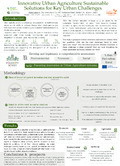
A general literature review was conducted to understand the intersections between
innovation and UA and to identify concrete examples of innovative systems. Concurrently, we analyzed the main challenges UA faces to better frame innovation needs. In parallel, applied research was carried out via a stakeholder survey and interviews with international experts. This qualitative approach allowed us to identify emerging innovative practices, collect on-the ground data, and uncover new research directions from active UA actors globally.
This combined methodology helps build a comprehensive understanding of innovation in UA and supports its strategic development.