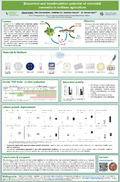
[en] Traditional agriculture faces multiple challenges, including climate change, global population growth and soil degradation. Agricultural alternatives must be developed and improved to complement the intensively exploited soil-based production systems. Soilless cropping systems such as hydroponics and aquaponics might overcome these rising challenges by reducing water input, optimizing resource use and lowering the space footprint while increasing yields. However, these systems can present challenges such as imbalance in nutrient availability and vulnerability to waterborne diseases. Development and application of microbial treatment combining multiple strains with biostimulant and biocontrol activity could increase the durability of soilless agriculture.
Previous research in our lab has isolated, selected and characterized bacterial strains from an aquaponic system. Biostimulation-related functional traits such as siderophore and indole acetic acid (IAA) production as well as potassium and phosphorus solubilization have been highlighted through colorimetric assays and allowed the selection of 6 strains. A cross-streak test on solid media revealed no antagonism between the selected strains, thus enabling the design of a multi-strain consortium. Further, the bacterial strains were combined and used in vivo as a treatment to improve lettuce’s (Lactuca sativa var. Lucrecia) growth in nutrient solutions originating from Oncorhynchus mykiss (Rainbow Trouts) and Cyprinus carpio carpio (Koï Carps) farming effluents. In most of the trials, measured growth parameters (fresh and dry shoot mass, dry root mass) were significantly improved by the addition of a multi-strain bacterial treatment but variability was noticed, and further assays must be made to assess and fine-tune the consortium’s efficacy and robustness across repetition and cropping system. In a previous study, biocontrol activity of one of the 6 selected strains (PB30) was evaluated against Pythium aphanidermatum, a recurrent pathogen in soilless agriculture. The bioassays’ results showed decreased seedling damping-off and significant reduction of disease symptoms on 31-day-old lettuce. Next phase is to explore (1) the biocontrol range of PB30 by performing dual culture assays on various, commonly found pathogens in soilless agriculture and (2) the persistence of functionally relevant traits when the strains are combined with each other. Thus, offering a bio-solution that can mitigate pathogens’ effects and assist plants’ development in soilless cultivation systems.
A key element that will be developed later is the plant microbiota response to both pathogen and bacterial treatment. Even though soilless cultivation systems are set to play a more significant role in the future, plant-microbe interactions in soilless systems have been less studied than in their soil-based counterpart. It is of prime importance to characterize the microbiota of such systems both taxonomically and functionally.
Research Center/Unit :
TERRA Research Centre. Gestion durable des bio-agresseurs - ULiège
Disciplines :
Agriculture & agronomy Microbiology
Author, co-author :
Parisis, Olivier ; Université de Liège - ULiège > Département GxABT > Gestion durable des bio-agresseurs
Stouvenakers, Gilles ; Université de Liège - ULiège > Département GxABT > Gestion durable des bio-agresseurs
Eck, Mathilde ; Université de Liège - ULiège > Département GxABT > Gestion durable des bio-agresseurs
Massart, Sébastien ; Université de Liège - ULiège > Département GxABT > Gestion durable des bio-agresseurs
Jijakli, Haissam ; Université de Liège - ULiège > Département GxABT > Gestion durable des bio-agresseurs
Language :
English
Title :
Biocontrol and biostimulation potential of microbial consortia in soilless agriculture.
Publication date :
20 May 2025
Event name :
76th ISCP - International Symposium on Crop Protection