Abstract :
[en] As the availability of phytopharmaceutical products for farmers declines, new and more sustainable alternatives are gaining attention, particularly bio-sourced active substances such as essential oils. These complex hydrophobic mixtures, predominantly composed of terpenoids and phenylpropanoids, have shown for decades biological properties of interest, notably to control phytopathogens. While most research has focused on the fungicidal activities of these substances, their effects on plants in this framework remain underexplored.
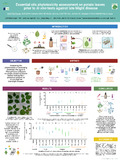
In this study, in vitro assays first quantified the anti-oomycete potential of several essential oils on both mycelium growth and spores’ germination of three Phytophthora infestans genotypes (EU-13, EU-36 and EU-37-A2), the oomycete responsible for potato late blight disease. Then, ex vivo tests confirmed the compatibility of those strains on detached leaves of three varieties of Solanum tuberosum known for their gradual sensitivities to late blight – Bintje (very susceptible) Fontane, Carolus (resistant). Eventually, the impacts of essential oils on plant tissues were examined. For this purpose, detached leaves were treated with a formulation at 1/5 (v/v) of Tween20 with various concentrations of essential oils (0,02; 0,1; 0,5; 2,5; 12,5 µL/mL) emulsified in water. Phytotoxicity was assessed 4 days later by measuring lesion length and quantifying surface chlorophyll content via fluorescence.
Both experiments in Petri dishes and on microplates showed that clove (Syzygium aromaticum), oregano (Origanum vulgare) and cinnamon (Cinnamomum zeylicanum) essential oils exhibit the strongest activities against P. infestans with complete inhibition reached at 1 µL/mL. Moreover, host-strain compatibilities were confirmed since severe symptoms appeared on both sensitive varieties although only very weak sign of the disease was detected on the most resistant one. Finally, no differences in chlorophyll content were observed between control and leaves treated with microemulsions at the four lowest concentrations of essential oils. However, signs of chlorosis appeared from 2,5 µL/mL, defining therefore phytotoxicity threshold.
In conclusion, this work has so far demonstrated the potential of specific essential oils as promising biocontrol method against P. infestans, while highlighting their phytotoxicity on S. tuberosum. The identified concentration range should allow for efficient protection against the pathogen without damaging the host plant. With confirmed compatibility between pathogenic strains and host varieties, further in planta evaluation of the protective properties of those bioactive molecules are now warranted on the pathosystem.