Abstract :
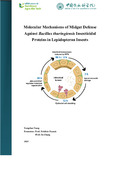
[en] Bacillus thuringiensis (Bt) is widely utilized in microbial insecticides and genetically modified crops for effective pest management. Its insecticidal proteins disrupt the midgut epithelium by forming pores, ultimately causing larval mortality. The insect midgut plays a vital role in digestion and nutrient absorption while also serving as a protective barrier against toxins and pathogens. These defense mechanisms can diminish the effectiveness of Bt-based products and potentially contribute to resistance development. This study investigated the specific midgut defense mechanisms induced by sublethal concentrations of Bt insecticidal proteins in lepidopteran insects. Additionally, a lepidopteran midgut defense gene research system based on RNA interference (RNAi) was established. Using this system, the study explored the genes and pathways involved in the midgut defense response of lepidopteran larvae against Bt insecticidal proteins.
In Chapter 3, the midgut defense mechanisms of Chilo suppressalis larvae against Bacillus thuringiensis Cry9A protein were elucidated using histopathological, molecular, and biochemical analyses. The results showed that a sublethal concentration of Cry9A (LC20) induced structural remodeling of midgut tissue, including epithelial cell shedding and midgut regeneration. Rapid Cry9A-induced midgut damage was observed, characterized by 20-30% reductions in epithelial thickness and cell loss within 48 hours, followed by full recovery by 96 hours. Cell shedding was quantified via aminopeptidase N (APN) release, showing an increase in luminal activity at 24 hours. Regeneration involved intestinal stem cell (ISC) proliferation, evidenced by phospho-histone H3 (PH3) upregulation, and Notch-mediated differentiation, with Delta expression peaking at 72 hours. These findings demonstrate a biphasic response - elimination of damaged cells and subsequent repair - orchestrated by ISC activation, providing insights into lepidopteran adaptive strategies against Bt toxins.
In Chapter 4, we focused on the homologous genes of Epidermal Growth Factor Receptor (Egfr) and Stathmin 4 (Stmn4), which have been reported to regulate stem cell proliferation and cell cycle progression in Drosophila, and applied them to Spodoptera frugiperda, a major migratory agricultural pest, to establish an efficient RNAi-based system for studying midgut defense genes in lepidopteran pests. Our results demonstrated that, compared to the E. coli-expressed dsRNA, in vitro synthesized dsRNA exhibited significantly higher gene silencing efficiency, especially when complexed with star polycation (SPc) nanoparticles. When fed at a concentration of 25 μg/g for 48 hours, the gene silencing efficiency reached over 75%. Pre-treatment with dsRNA for 48 hours increased the larval mortality rate by more than 30% following Cry1F exposure, outperforming the simultaneous feeding method of dsRNA and Cry1F protein. Furthermore, the silencing of SfEgfr and SfStmn4 inhibited the proliferation of midgut stem cells after Cry1F exposure, leading to an increased mortality rate. Our findings offer a novel concept and theoretical framework for the biological management of lepidopteran pests.
In Chapter 5, Cry9A-induced intestinal regeneration is regulated by Jun N-terminal kinase (JNK) and the Janus kinase/signal transducer and activator of transcription (JAK/STAT) signaling pathway. These factors mediate gut regeneration by promoting intestinal stem cell proliferation and differentiation, offering protection against three different Bt proteins, including Cry9A, Cry1F, and Vip3A, in Chilo suppressalis and Spodoptera frugiperda. To enhance pesticide efficacy, a nano-biopesticide was developed by combining Stat double-stranded RNA (dsRNA) nanoparticles with Bt strains. This formulation demonstrated superior pest control, suggesting its potential to reduce reliance on synthetic insecticides in agricultural environments.
Overall, we identified that the JNK/JAK/STAT pathway regulates midgut regeneration in lepidopteran larvae following pore formation induced by Bt pore-forming toxins (PFTs). Furthermore, we demonstrated that RNAi-mediated silencing of the JAK/STAT pathway enhances the toxicity of different PFTs in two distinct lepidopteran species. Based on these findings, we developed a novel and effective formulation combining Bt and dsStat nanopesticides for controlling Chilo suppressalis and Spodoptera frugiperda larvae. This innovative strategy, which integrates Bt strains with dsRNA targeting insect defense mechanisms, offers a promising approach for managing crop pests that exhibit low susceptibility to Bt PFTs.
Institution :
ULiège - University of Liège [GEMBLOUX AGRO-BIO TECH], GEMBLOUX, Belgium
CAAS - Chinese Academy of Agricultural Sciences [Institute of Plant Protection], Beijing, China