Poster (Scientific congresses and symposiums)
What aspects of familiarity are linked to the volumes of the perirhinal and entorhinal cortices, the first regions affected in Alzheimer’s disease?
Servais, Anaïs; Frick, Aurélien; Meyer, François et al.
2025Cognitive Neuroscience Society (CNS)
Editorial reviewed
 

Files


Full Text
FAM CNS Poster.pdf
Author postprint (2.22 MB) Creative Commons License - Attribution
Download

All documents in ORBi are protected by a user license.

Send to


Details


Keywords :
familiarity; aging; episodic memory; alzheimer's disease; mild cognitive impairment
Abstract :
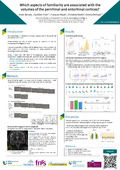
[en] The perirhinal (PrC) and the anterolateral entorhinal (alErC) cortex are among the first brain regions impacted by Alzheimer’s Disease (AD). While their role in cognition remains unclear, recent models propose that these regions support episodic and lifetime (or absolute) familiarity when discriminating highly overlapping concepts is necessary. The present study assessed episodic familiarity judgments (task 1) and lifetime familiarity judgments (task 2), using materials with varying levels of conceptual overlap and lifetime familiarity for lures and targets (task 3). The study involved 57 older participants (aged 55+), including healthy individuals and those with either Subjective or Mild Cognitive Impairment. Volumes of the PrC, alErC, and hippocampal subfields were measured using structural MRI. As hypothesized, results suggest the PrC and the alErC volumes are linked with familiarity processes when discriminating highly overlapping concepts is required. This can be interpreted in line with recent ideas suggesting that familiarity feelings emerge from distinct neural pathways depending on the type of representations–PrC being involved in fine-grained representations. Moreover, clustering analysis revealed three distinct subgroups: one including healthy individuals, another including predominantly patients with established memory impairment, and a third, more heterogeneous group, which may represent preclinical cognitive decline. Participants in this subgroup appear to rely on familiarity to compensate for impaired recollection and commit more false alarms. Their recognition accuracy also decreases as conceptual overlap increases. We discuss how the pattern of performance across our three tasks highlights the promise of combining familiarity-related tasks to detect subtle cognitive changes associated with preclinical AD.
Research Center/Unit :
GIGA CRC (Cyclotron Research Center) In vivo Imaging-Aging & Memory - ULiège
Disciplines :
Neurosciences & behavior
Author, co-author :
Servais, Anaïs  ;  Université de Liège - ULiège > Département de Psychologie
Frick, Aurélien  ;  Université de Liège - ULiège > Département des sciences cliniques ; School of Psychology and Neuroscience, University of St Andrews, UK
Meyer, François  ;  Université de Liège - ULiège > Département des sciences cliniques
Bastin, Christine  ;  Université de Liège - ULiège > GIGA > GIGA Neurosciences - Aging & Memory ; Université de Liège - ULiège > Département de Psychologie : cognition et comportement
Delhaye, Emma  ;  Université de Liège - ULiège > GIGA > GIGA Neurosciences - Aging & Memory ; CICPSI, Faculdade de Psicologia, Universidade de Lisboa, Portugal
Language :
English
Title :
What aspects of familiarity are linked to the volumes of the perirhinal and entorhinal cortices, the first regions affected in Alzheimer’s disease?
Publication date :
30 March 2025
Event name :
Cognitive Neuroscience Society (CNS)
Event place :
Boston, United States
Event date :
29th March - 1st April
Audience :
International
Peer review/Selection committee :
Editorial reviewed
Available on ORBi :
since 01 April 2025

Statistics


Number of views
117 (14 by ULiège)
Number of downloads
32 (6 by ULiège)

Bibliography


Similar publications


Contact ORBi