[en] INTRODUCTION: Event segmentation refers to parsing the continuous flow of our daily activities into discrete meaningful events (Richmond et al., 2017). Non-normative segmentation (i.e., when individuals do not identify the same event boundaries as others) has been associated with poorer memory performances in both healthy individuals and those with acquired brain injury (ABI; Zacks et al., 2016). This may partly explain the episodic memory difficulties frequently observed in this clinical population (Vakil et al., 2019). However, these results were obtained in a laboratory setting by asking participants to segment third-person videos. It remains to be determined whether the segmentation difficulties of brain-injured patients can be observed using a more ecological paradigm (inspired by the one used in Jeunehomme & D’Argembeau, 2020), and their impact on personal everyday memories.
OBJECTIVE: Examining the segmentation abilities of brain-injured patients with an ecological segmentation task and determining whether these abilities predict everyday events memories assessed with a paradigm based on the sampling of daily life experiences.
METHODS: Seven brain-injured patients and their matched controls were asked to perform a series of actions during a walk on a university building with a wearable camera. One week later, they were presented with a video of their walk and were instructed to segment it into meaningful events. Participants’ everyday memories were assessed by sampling their daily life experiences. Specifically, participants had to answer questions sent to their smartphone 5 times a day for one week about what they were doing at the present time (the people they were with, the emotions they were feeling, the place where they were, etc.). At the end of the week, they were asked to verbally report 5 of these personally experienced events in as much detail as possible. An accuracy score was obtained by comparing information from their verbal reports to those recorded on the mobile application.
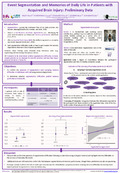
RESULTS: Healthy participants had a significantly better segmentation agreement than the clinical group (t = -4.35 ; p <.001 ; d = -2.02) and their memories of everyday events were more accurate (t = -2.31 ; p = .03 ; d = -1.07). The linear regression exploring if the segmentation score predicted memory performance on the whole sample did not reach significance (t = 0.96 ; p = .35 ; f² = 0.32) but this could be explained by the small number of participants.
DISCUSSION: These preliminary results seem to confirm the segmentation difficulties of brain-injured patients and provide new insights into the cognitive changes that occur after an ABI. A larger sample will enable us to determine whether these difficulties are predictive of memory performance in everyday life, which could open new avenues for rehabilitation programs aiming at reducing memory difficulties by training brain-injured patients to segment in a more normative way.
Disciplines :
Theoretical & cognitive psychology
Author, co-author :
Billet, Maud ; Université de Liège - ULiège > Département de Psychologie > Neuropsychologie de l'adulte ; F.R.S.-FNRS - Fund for Scientific Research
D'Argembeau, Arnaud ; Université de Liège - ULiège > Département de Psychologie ; F.R.S.-FNRS - Fund for Scientific Research
Stawarczyk, David ; Université de Liège - ULiège > Département de Psychologie ; F.R.S.-FNRS - Fund for Scientific Research
Geurten, Marie ✱; Université de Liège - ULiège > Département de Psychologie > Neuropsychologie de l'adulte ; F.R.S.-FNRS - Fund for Scientific Research
Willems, Sylvie ✱; Université de Liège - ULiège > Psychologie et Neuroscience Cognitives (PsyNCog)
✱ These authors have contributed equally to this work.
Language :
English
Title :
Event Segmentation and Memories of Daily Life in Patients with Acquired Brain Injury: Preliminary Data