SK channels; AlphaFold; Molecular Docking; Patch clamp; Binding Assay
Abstract :
[en] Small conductance calcium-activated potassium (SK / KCa2) channels are selective for K+ ions and are gated by Ca2+ via calmodulin molecules. Three isoforms (SK1-3 ; encoded by KCNN1-3) have been identified, showing different but overlapping tissue expression, notably in the heart and the central nervous system (CNS). For example, SK1 and SK2 proteins display considerable overlap in regions including cortex and hippocampus while SK3 expression is higher in the monoaminergic cell regions. SK channels are known to play an important role in neuronal excitability by modulating the firing rate and firing pattern of neurons. As a result of their physiological roles and distribution, they represent potential targets for the treatment of disorders such as schizophrenia, depression, Alzheimer’s and Parkinson’s disease or atrial fibrillation. Blockers of these channels such as apamin or UCL-1684 exist but can’t be used as a therapeutical tool due to their narrow therapeutic window or their lack of selectivity. Therefore, the development of new non-peptidic blockers combining high affinity and selectivity towards SK2 or SK3 channels is crucial and requires a better knowledge of the structural features essential to the affinity of these ligands.
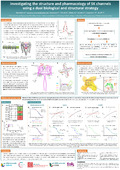
In this project, we aim to better understand the interaction between SK channels and the archetypical blocker apamin by studying the 3D structures of SK proteins and their activity. From models obtained using AlphaFold, we observed a particular conformation of the S3S4 loop in SK1, 2 and 3, which does not seem to be present in SK4 (or IK – Intermediate conductance potassium channel). Furthermore, in the first three subtypes, we observed the presence of a phenylalanine residue in this loop that appears to be located just outside the channel pore and could play a key role in interaction with apamin. To validate this hypothesis, we generated different mutants of this phenylalanine in SK2 and SK3 channels and studied their activity and sensitivity to apamin and UCL-1684 by coupling molecular docking to in vitro patch-clamp experiments.
Disciplines :
Biochemistry, biophysics & molecular biology
Author, co-author :
Mouchet, Antoine ; Université de Liège - ULiège > Integrative Biological Sciences (InBioS)
Nadenoen, Théo ; Université de Liège - ULiège > Département des sciences de la vie > Centre d'Ingénierie des Protéines (CIP)
Vitello, Romain ; Université de Liège - ULiège > Unités de recherche interfacultaires > Centre Interdisciplinaire de Recherche sur le Médicament (CIRM)
Brans, Alain ; Université de Liège - ULiège > Département des sciences de la vie > Centre d'Ingénierie des Protéines (CIP)
Seutin, Vincent ; Université de Liège - ULiège > Département des sciences biomédicales et précliniques > Pharmacologie
Liégeois, Jean-François ; Université de Liège - ULiège > Département de pharmacie > Chimie pharmaceutique
Kerff, Frédéric ; Université de Liège - ULiège > Département des sciences de la vie > Centre d'Ingénierie des Protéines (CIP)
Language :
English
Title :
Investigating the structure and pharmacology of SK channels using a dual biological and structural strategy