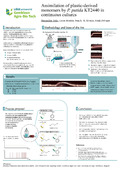
[en] Bio-based recycling strategies hold promise for the sustainable management of plastic pollution. Despite their potential, these approaches currently face challenges such as high fermentation costs and slower decomposition rates compared to conventional chemical methods. Productivity was increased by connecting abiotic factors with biological processes, for instance, cryo-shredding as a pretreatment, resulting in a mixture of degradable compounds. The drawback of multiple substrates is challenged with the use of synthetic consortia of specialists, strains that are able to utilise only one compound, increasing yield and productivity by removing catabolite repression.
Automated flow cytometry allows the observation of cellular entropy, describing mechanisms leading to heterogeneity in bioprocesses. Recent research has demonstrated that genetic circuits with high heterogeneous output can be controlled by exposing the culture to phases of induction and relaxation. Pseudomonas putida shows a wide spectrum of pathways consuming aromatic and aliphatic compounds, making it one of the most favoured organisms to fight plastic pollution. However, the growth inhibition, catabolic repression, and cellular damage caused by these compounds lead to challenges in maintaining robust continuous cultures.
In my approach, I want to investigate the cellular entropy of Pseudomonas putida KT2440 in exposure to benzoic acid and ethylene glycol in continuous cultures. The objective is to investigate cellular noise in processes with one compound, both compounds simultaneously and the specialist approach. In each process, constant feeding on maximum conversion rate will be compared to a process allowing phases of induction and relaxation.
This investigation holds the potential to identify pulse frequencies that could enable robust continuous cultures using synthetic consortia, thereby advancing our understanding of sustainable bio-based recycling solutions for plastic pollution.
Disciplines :
Biotechnology
Author, co-author :
Tieke, Maximilian ; Université de Liège - ULiège > Département GxABT > Microbial technologies