Biocontrol, VOC's, Behavioral response, Honeydew, Aphid control
Résumé :
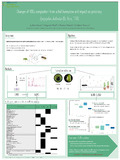
[en] The use of natural enemies to control aphids often faces management challenges in terms of spatial distribution and tritrophic interactions. In the last few years, particular interest has been shown in honeydew, a liquid rich in sugars and amino acids secreted by the aphid and previously considered as a metabolic waste product. Honeydew has been shown to be the site of interaction of many bacteria, some of which produce volatile compounds that stimulate some of the aphid's natural enemies. In this context, we focused on the volatolome of honeydew and the factors that can influence its composition. Since the composition of honeydew depends mainly on the aphid host plant but especially on the excreting aphid species, we assumed the same for the honeydew volatile organic compounds (VOCs). We therefore analysed the odor profile of honeydew from two aphid species. Moreover, as some of these compounds are produced by honeydew bacteria, honeydews with different microflora could have different volatile profiles. Therefore, we performed VOC’s analyses on honeydew that had undergone natural ageing. Volatile compounds were extracted from honeydew by SPME and analysed by GCMS. The honeydews showed several common compounds but also qualitative and quantitative differences in their volatolome according to ageing. Behavioural tests in a flight tunnel with these different honeydews showed differences in attraction and oviposition induction in the marmalade hoverfly. Therefore our study suggests that the aphid species and the microbiota strongly influence the semiochemicals associated with honeydew and then the behavioral changes induced in the natural enemies.
Disciplines :
Entomologie & lutte antiravageur
Auteur, co-auteur :
Glacet, Lallie ; Université de Liège - ULiège > Département GxABT > Gestion durable des bio-agresseurs
Noël, Grégoire ; Université de Liège - ULiège > Département GxABT > Gestion durable des bio-agresseurs
Martin, Clément ; Université de Liège - ULiège > Département GxABT > Gestion durable des bio-agresseurs
Francis, Frédéric ; Université de Liège - ULiège > TERRA Research Centre > Gestion durable des bio-agresseurs
Langue du document :
Anglais
Titre :
Changes of VOC's composition from aphid honeydew and impact on predatory Episyrphus balteatus (De Geer, 1776)
Date de publication/diffusion :
septembre 2022
Nom de la manifestation :
Advances in separation science From extraction to chromatographic applications