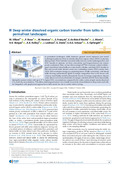
[en] In permafrost landscapes, taliks (unfrozen ground zones) represent year round hydrological pathways that can transfer dissolved organic carbon (DOC) to streams during winter. When laterally connected, taliks enhance winter hydrological flow and DOC transfer to streams, yet their connectivity and biogeochemical role remain poorly constrained. Here, we use silicon isotopes (δ30Si) in soil pore waters to distinguish closed from lateral taliks at a water track in Alaska, and study DOC transfer to first and second order streams across two contrasting winters (2025 warmer than 2024). Silicon isotopes emerge as a promising tracer of talik connectivity, with lateral taliks showing systematically lighter Si isotope composition than in the frozen soil, whereas closed taliks exhibit systematically heavier Si isotope compositions. Stream water data reveal enhanced transfer of younger, soil derived DOC from lateral taliks during the warmer winter, with up to 57 % higher DOC concentrations compared to the colder winter, despite similar dissolved CO2 and CH4 concentrations. This offers a first biogeochemical view of talik connectivity (closed/lateral) in deep winter and calls for integration with geophysical approaches to fully resolve its role in winter carbon cycling.
Research Center/Unit :
FOCUS - Freshwater and OCeanic science Unit of reSearch - ULiège
Disciplines :
Aquatic sciences & oceanology
Author, co-author :
Villani, M
Roux, P
Henrion, M
François, S
du Bois d’Aische, E
Monin, L
Borges, Alberto ; Université de Liège - ULiège > Freshwater and OCeanic science Unit of reSearch (FOCUS)
Kelley, A.K.
Ledman, J.
Denis, G
Schuur, E.A.G.
Opfergelt, S.
Language :
English
Title :
Deep winter dissolved organic carbon transfer from taliks in permafrost landscapes