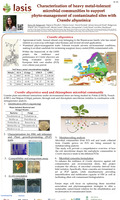
[en] Soil restoration and the development of renewable bio-based products are major priorities of the European Union within the framework of Soil and bioeconomy strategies. Phytomanagement approaches involving plants and associated microorganisms are essential to achieve these goals.
Crambe abyssinica L. (Crambe), an annual oilseed crop belonging to the Brassicaceae family, is an emerging industrial crop for the phytomanagement of heavy metal (HM)-contaminated sites, providing opportunities for a more sustainable bio- and circular economy, through bioproduct valorization combined with soil restoration. The crop gained attention due to several traits, including low input requirements with high performance, high-value biomass and oilseed applications, and demonstrated tolerance to adverse environmental conditions. It was previously shown that accumulation of Cd, Zn and Pb primarily occurs in roots, stems, and seed residues.
Within the framework of the IASIS project (CBE-JU Funding, 2024-2028), Crambe plant-microbiome interactions under environmental stress are being studied at four HM-contaminated Field Case Study sites (FCSs) distributed across Europe (France, Belgium, Poland, and Greece), through seed and rhizosphere microbiome isolation in combination with metagenomics analysis. For this purpose, bacterial and fungal isolation was performed from the Crambe rhizosphere and harvested seeds upon growth on FCS soils. Bacterial and fungal strains have been identified through ribosomal RNA sequencing, and their plant growth-promoting properties, as well as their HM tolerance, are currently being characterized. In addition, metabarcoding analyses of contaminated soils and seeds are underway, to provide information on how the soil microbiome is shaping endophytic communities in the seeds.
These data will support the development of a model describing interactions between Crambe and associated microorganisms, highlighting the major microbial groups involved as potential agents promoting plant growth and soil health.