Face learning; Hairstyle variability; Scene learning; Trade-off; Cost-efficient encoding hypothesis; Eyetracker
Abstract :
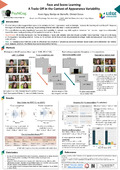
[en] In daily life, we meet individuals in varying contexts, and their appearance may change to varying degrees between encounters. Although variability in appearance may initially make face learning more challenging, prior research has demonstrated that it ultimately enhances recognition accuracy (Devue & de Sena, 2023, Cognition). Here, we investigated whether memory advantages from exposure to variable appearances come at the cost of memory for contextual information and for face-scene associations. We hypothesised that inner features of faces that were learned with variable appearances would be memorised in a robust but decontextualized manner, leading to improved recognition performance for faces but not for scenes or face-scene associations. In contrast, we expected that faces with a stable appearance and the surrounding scenes should be memorised in a global manner, yielding relatively poorer face recognition with better scene recognition and stronger face-scene associations. To test these hypotheses, we conducted a pre-registered study (N = 64) examining how variability in appearance (stable vs. variable hair colour and style) influences face and scene learning. Participants learned six images of eight new faces, each embedded in two distinct scenes. After a 5-min delay, face recognition was tested using pictures displaying only inner facial features. Scene recognition and memory for face-scene associations were also tested to investigate memory for the extrinsic context and decontextualisation, respectively. Eye-tracking data were collected throughout the entire experiment to determine the spatial distribution of visual attention. Results show better overall recognition for scenes associated with stable faces and for their association. A trend also suggests that exposure to variability may improve inner-feature recognition, even though these features were fixated less in that condition. Taken together, these findings suggest that variability in facial appearance favours the encoding of inner facial features at the expense of contextual information.
Disciplines :
Theoretical & cognitive psychology
Author, co-author :
Nguy, Kévin ; Université de Liège - ULiège > Psychologie et Neuroscience Cognitives (PsyNCog)
de Marneffe, Maëlys ; Université de Liège - ULiège > Faculté de Psychologie, Logopédie et Sciences de l'Education > Master sc. psycho., fin. spéc.
Devue, Christel ; Université de Liège - ULiège > Département de Psychologie > Psychologie et neurosciences cognitives ; Université de Liège - ULiège > Psychologie et Neuroscience Cognitives (PsyNCog)
Language :
English
Title :
Face and Scene Learning: A Trade-off in the Context of Appearance Variability
Alternative titles :
[fr] Apprentissage des visages et des scènes: un équilibre en présence de la variabilité d'apparence
Publication date :
25 August 2026
Event name :
European Conference on Visual Perception 2026 (ECVP 2026, Bournemouth, UK)