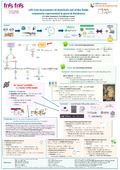
Abstract :
[en] Nowadays, companies are increasingly required to provide environmental information about their products, whether for direct customers (B2B, B2C) or to meet the requirements of authorities (regional, national or European).
While databases are relatively well developed for the most common elements (such as ecoivent, Sphera, Carbon Minds, etc.), many chemicals that can be grouped under the term "additives" remain undocumented.
There are several reasons for this, including the low volumes produced, which do not justify the implementation of specific modelling, but also – and above all – the difficulties associated with confidentiality and the secrecy surrounding their formulation.
Typical examples are plasticisers for concrete or flame-retardants.
Competition in the sector makes data collection very complex, with many barriers being erected even when proposing the signing of non-disclosure agreements (NDAs).
In most cases, relatively vague generic background data is incorporated into the models. Typically, in a database such as ecoinvent, additives added in small quantities are approximated by "chemical, (in)organic" – which includes some of the most representative substances in these categories, based on a "better than nothing" philosophy.
More specific databases such as the one offered by Carbon Minds do not document those substances either, and a customised datased becomes very costly.
Fortunately, changes in regulations such as REACH have led to the production of safety data sheets, which indicate the substances (at least the potentially problematic ones), used in the composition of a product. From there, an attempt at modelling can be made by delving into the mysteries of synthetic chemistry and estimating energy consumption based on other processes of the same family that are available in the databases. It should be noted, of course, that these processes are often non-specific but average values considered being representative!
However, for "technological" products such as fire-resistant fabrics, comparing different products with the same functionality (e.g. fire resistance for a given period of time) becomes complex, since the specific characteristics of a new fabric with superior performance cannot be precisely characterised, leading to inaccurate environmental impact values, whether over- or underestimated.
In the context of a hyper-competitive market where technical performance is no longer a sufficient argument for winning contracts, but where environmental performance must also convince customers, realisation of life cycle assessments for these products poses a complex question for both producers and LCA experts responsible for preparing the environmental declarations required by the market. The same question naturally arises upstream at the eco-design stage: an innovative product must not only demonstrate its effectiveness, but also its environmental "virtues", otherwise it may encounter obstacles to its commercialisation, whether in terms of its market launching or its attractiveness.
The purpose of this presentation is to highlight these difficulties and to share the pathways we are exploring in our practice in an attempt to answer to them as rigorously as possible.