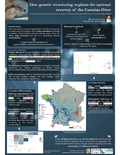
[en] After a dramatic collapse in the 20th century that fragmented its once continuous distribution, the Eurasian otter (Lutra lutra) is now undergoing a remarkable natural recovery across France. Using non-invasive sampling and genotyping at 14 microsatellite loci, we analysed populations at the national scale and identified five to six genetic clusters. Their geographic organisation reflects the locations of modern refugia where remnant populations persisted through the species’ demographic bottleneck, yet without exhibiting the severe genetic erosion typically expected after such declines.
Although the genetic structure is clear and spatially coherent, numerous admixed individuals reveal active contact zones and an increasing reconnection among formerly isolated lineages. Long-distance dispersal events and mixing across cluster boundaries underline the species’ high mobility and emphasize the central role of hydrological connectivity in facilitating gene flow. This renewed admixture appears to reinforce genetic diversity and may contribute to the current recolonisation dynamics, in a pattern reminiscent of expansion processes observed in species with multiple genetic sources.
Crucially, no evidence of marked genetic depletion or reproductive impairment was detected, despite persistent anthropogenic pressures such as water pollution, habitat degradation and fluctuating prey availability. The French otter recovery thus represents a rare, large-scale example of natural recolonisation in a mammal, sustained by refugial persistence, restored connectivity and enhanced lineage mixing.
These results highlight the species’ strong dispersal capacity and evolutionary resilience (traits shared with other recovering European carnivores) and stress the importance of maintaining functional freshwater habitats, sufficient food resources, and ecological corridors to support long-term gene flow within this expanding national population.
Disciplines :
Zoology
Author, co-author :
Beaumariage, Anaïs ; Université de Liège - ULiège > Département des sciences de la vie > Laboratoire de génétique de la conservation
Language :
English
Title :
How genetic structuring explains the national recovery of the Eurasian Otter
Alternative titles :
[fr] Comment la structuration génétique explique le rétablissement national de la loutre d'Europe
Original title :
[en] How genetic structuring explains the national recovery of the Eurasian Otter