Abstract :
[en] Complex algae are photosynthetic organisms scattered across the eukaryotic tree (Sibbald
& Archibald, 2020). However, the exact mechanisms by which their plastids were acquired
remain unclear. Contrary to expectations of secondary endosymbiotic models, a sizable part
of plastid-targeted genes does not match the plastid itself (Dorrell et al., 2017). For CASH
lineages (bearing complex red plastids (Petersen et al., 2014)), ancestral cryptic serial
endosymbiosis (Moustafa et al., 2009) and the shopping bag model (Morozov &
Galachyants, 2019) models, provide possible interpretations of gene mosaicism but focus
on endosymbiotic mechanisms. In contrast, while the Rhodoplex hypothesis fits the single
phylogenetic origin of those plastids (Petersen et al., 2014; Gould et al., 2015), it does not
explain gene mosaicism. Moreover, it implies multiple tertiary (or quaternary) endosymbiotic
events, whereas most complex algae do not bear nucleomorphs and only have three or four
membranes surrounding their plastids (Grosche et al., 2014). To overcome these
inconsistencies, kleptoplasty was suggested as an additional mechanism for explaining
plastid spread (Bodył, 2018), not only in CASH lineages but also in euglenids (Karnkowska
et al., 2023). In line with the shopping bag model, this hypothesis posits multiple transient
interactions with prey of diverse origins but also proposes a rationale for the selective force
driving the progressive accumulation of plastid-targeted genes: to maintain functional
kleptoplastids for increasingly longer periods of time (Hehenberger et al., 2019), before
ultimately reducing them into fully integrated plastids. In such a scenario, the phylogenetic
diversity of nucleus-encoded plastid-targeted genes would be higher than predicted with the
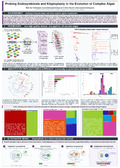
endosymbiotic models. To test the idea, we designed an automated phylogenetic pipeline
for detecting transfers in single-gene trees in a discovery-driven and taxonomy-aware
fashion. Then, by transforming individual transfer events into organism-centric alpha-diversities, we probed the relative contribution of endosymbiosis and kleptoplasty in the origin of complex algae.