whey; gut microbiota; INFOGEST; in vitro digestion
Abstract :
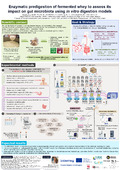
[en] Whey, a by-product of cheese production, remains largely underutilized and is often considered as waste, raising environmental concerns within the dairy sector. However, whey is a rich source of high-quality proteins and bioactive compounds contributing to host health. Its valorization therefore represents a promising strategy to reduce environmental impact and develop sustainable, value-added food products. In addition, whey-derived substrates may reach the colon, where they can interact with the gut microbiota and be metabolized into bioactive compounds potentially influencing intestinal health and microbial activity. Nevertheless, studying these microbiota-driven effects remains challenging, as digestion and absorption processes occurring in the upper gastrointestinal tract must be accurately simulated to determine the fraction that effectively reaches the colon.
This study aims to evaluate the enzymatic predigestion and absorption of whey prior to assessing its impact on the intestinal microbiota.
Since whey proteins and simple sugars are primarily digested and absorbed in the proximal gastrointestinal tract, it is essential to characterize these processes before investigating colonic effects. This step will be carried out using the INFOGEST 2.0 protocol developed within the COST INFOGEST Action (Brodkorb et al., 2019; Minekus et al., 2014). The outcome of this phase will be a predigested whey-based product suitable for inoculation into more complex in vitro digestive fermentation models such as the SHIME system (Goya-Jorge et al., 2024).
This work is currently in progress. Preliminary efforts focus on optimizing enzyme concentrations and digestion conditions during gastric and ileal phases.
This approach is expected to improve our understanding of how whey-derived compounds influence microbiota-driven responses, supporting the development of sustainable, value-added dairy products with potential benefits for intestinal health.
This research is part of the ALAFERM project, an Interreg Greater Region initiative co-funded by the European Union, addressing the valorization of agri-food by-products and the sustainability of the dairy sector.
Disciplines :
Food science
Author, co-author :
Gresse, Manon ; Université de Liège - ULiège > Fundamental and Applied Research for Animals and Health (FARAH) > FARAH: Santé publique vétérinaire
Aguilar Trujillo, Ninive Montserrat ; Université de Liège - ULiège > Fundamental and Applied Research for Animals and Health (FARAH) > FARAH: Santé publique vétérinaire
De Martinis, Clara; University of São Paulo > Faculty of Animal Science and Food Engineering - FZEA / USP
Gonza Quito, Irma Elizabeth ; Université de Liège - ULiège > Fundamental and Applied Research for Animals and Health (FARAH) > FARAH: Santé publique vétérinaire
Katsandegwaza, Brunette ; Université de Liège - ULiège > Fundamental and Applied Research for Animals and Health (FARAH) > FARAH: Santé publique vétérinaire
Delcenserie, Véronique ; Université de Liège - ULiège > Département de sciences des denrées alimentaires (DDA) > Gestion de la qualité dans la chaîne alimentaire
Language :
English
Title :
Enzymatic predigestion of fermented whey to assess its impact on gut microbiota using in vitro digestion models
Alternative titles :
[fr] Prédigestion enzymatique du lactosérum fermenté afin d'évaluer son impact sur le microbiote intestinal à l'aide de modèles de digestion in vitro
Original title :
[en] Enzymatic predigestion of fermented whey to assess its impact on gut microbiota using in vitro digestion models
Publication date :
18 June 2026
Number of pages :
1
Event name :
ONE HEALTH INTERNATIONAL DAYS 2026
Event place :
Liège, Belgium
Event date :
18/06/2026
Audience :
International
Peer review/Selection committee :
Editorial reviewed
Development Goals :
3. Good health and well-being 8. Decent work and economic growth 12. Responsible consumption and production