Abstract :
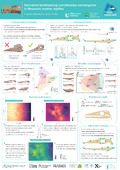
[en] During the Mesozoic, several reptile clades independently radiated into the marine realm. Aquatic environments impose strong constraints on feeding and mobility, which, in turn, drove morphological convergence in their cranial anatomy. Studies of form-function relationships in these groups have often relied on continuous and discrete traits, largely due to preservation biases, such as the prevalence of slab specimens. Landmark-based geometric morphometrics offers a more transparent representation of shape, yet the gap between these two methods has rarely been bridged. Here, we propose ‘derivative
landmarking’, a novel method to convert linear measurement datasets into fixed landmark coordinates that capture functionally relevant proportions of the skull and mandible. Using Mesozoic marine reptiles as a case study, we analyzed an extensive dataset of linear craniomandibular measurements. The resulting morphospaces reveal functional convergence among clades, notably among polycotylid plesiosaurians, slender-snouted pliosauroids, and ichthyosaurians. We then employed the R package Morphoscape to generate performance landscapes for key functional proxies, such as bite force and
jaw-opening speed, to test for convergence in performance rather than in general shape. High bite force values align with morphospace regions occupied by mosasaurids, thalattosuchians, and short-snouted elasmosaurids, while elevated jaw-opening speed characterizes polycotylids and ichthyosaurians. A combined adaptive landscape helped visualize the morphospace through functional optimality, underlying convergent optimal morphologies across unrelated lineages, such as mosasaurids and derived metriorhynchids. Derivative landmarking is proposed as a practical, accessible method for (i) extensive taxonomic sampling and (ii) repurposing existing linear datasets, enabling confirmation of previous findings and expanding morpho-functional analyses for groups heavily affected by preservation biases