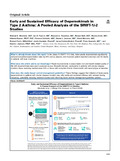
[en] BACKGROUND: Depemokimab, the first ultralong-acting biologic with enhanced IL-5 binding affinity, high inhibition potency, and extended half-life, enables twice-yearly dosing in patients with asthma. In phase III SWIFT-1/-2 trials, depemokimab significantly reduced the annualized exacerbation rate by 54% versus placebo with sustained suppression of inflammation assessed by blood eosinophil count in type 2 asthma. OBJECTIVE: To evaluate the onset and duration of depemokimab efficacy across each 26-week dosing period in the pooled SWIFT-1/-2 population and identify patient characteristics associated with enhanced clinical response. METHODS: Patients with type 2 asthma, independent of Asthma Control Questionnaire-5 (ACQ-5) status, were randomized 2:1 to receive depemokimab 100 mg subcutaneously or placebo every 26 weeks for 52 weeks. Prespecified end points included time to first exacerbation, St George's Respiratory Questionnaire or ACQ-5 scores, Asthma Nighttime Symptom Diary or Asthma Daytime Symptom Diary weekly scores, and rescue medication use over time. We conducted post hoc subgroup analyses by baseline characteristics. RESULTS: Depemokimab reduced the probability of first exacerbation over 52 weeks versus placebo by 46% (hazard ratio = 0.54; 95% CI, 0.43-0.69), with effects from week 4 sustained across both dosing periods. Annualized exacerbation rate reductions were most pronounced in patients with asthma disease duration less than 10 years, comorbid chronic rhinosinusitis with nasal polyps, and medium-dose ICS at baseline. Across each dosing period, depemokimab also improved St George's Respiratory Questionnaire, ACQ-5, Asthma Nighttime Symptom Diary, or Asthma Daytime Symptom Diary scores, particularly in patients with baseline ACQ-5 scores of 1.5 or greater, with sustained improvements in rescue medication. CONCLUSION: Early and sustained efficacy with depemokimab was observed across 26-week dosing periods in type 2 asthma, with enhanced benefits in patients with shorter disease duration who had not progressed to high-dose ICS.
Disciplines :
Cardiovascular & respiratory systems
Author, co-author :
Wechsler, Michael E; Division of Pulmonary, Critical Care, and Sleep Medicine, National Jewish Health, Denver, Colo.
Pavord, Ian D; Oxford Respiratory NIHR Biomedical Research Centre, Nuffield Department of Clinical Medicine, University of Oxford, Oxford, United Kingdom.
Panettieri, Reynold A; Rutgers Institute for Translational Medicine and Science, New Brunswick, NJ.
Buhl, Roland; Pulmonary Department, Mainz University Hospital, Mainz, Germany.
Kraft, Monica; Samuel Bronfman Department of Medicine, Icahn School of Medicine at Mount Sinai, New York, NY.
Rupani, Hitasha; Department of Respiratory Medicine, University Hospital Southampton NHS Foundation Trust, Southampton, United Kingdom.
Schleich, Florence ; Université de Liège - ULiège > Département des Sciences de l'activité physique et de la réadaptation > Physiologie humaine et physiologie de l'effort physique
Jackson, Daniel J; Department of Pediatrics, University of Wisconsin-Madison, Madison, Wis.
Kwiatek, Justin; Global Medical Affairs, GSK, Collegeville, Pa.
Vichiendilokkul, Anna; Global Medical Affairs, GSK, Collegeville, Pa.
Howarth, Peter; Global Medical Affairs, Respiratory Specialty Care, GSK, London, United Kingdom.
Jackson, David J; Guy's Severe Asthma Centre, Guy's and St Thomas' NHS Foundation Trust, London, United Kingdom, School of Immunology and Microbial Sciences, King's College, London, United Kingdom. Electronic address: david.jackson47@nhs.net.
Lloyd, A., Price, D., Brown, R., The impact of asthma exacerbations on health-related quality of life in moderate to severe asthma patients in the UK. Prim Care Respir J 16 (2007), 22–27.
Maspero, J., Adir, Y., Al-Ahmad, M., Celis-Preciado, C.A., Colodenco, F.D., Giavina-Bianchi, P., et al. Type 2 inflammation in asthma and other airway diseases. ERJ Open Res 8 (2022), 00576–2021.
Rupani, H., Kyyaly, M.A., Azim, A., Abadalkareen, R., Freeman, A., Dennison, P., et al. Comprehensive characterization of difficult-to-treat asthma reveals near absence of T2-low status. J Allergy Clin Immunol Pract 11 (2023), 2812–2821.e4.
Chan, R., Duraikannu, C., Lipworth, B., Clinical associations of mucus plugging in moderate to severe asthma. J Allergy Clin Immunol Pract 11 (2023), 195–199.e2.
Global Initiative for Asthma. Global strategy for asthma management and prevention. Accessed June 2025 https://ginasthma.org/2025-gina-strategy-report/.
Pelaia, C., Paoletti, G., Puggioni, F., Racca, F., Pelaia, G., Canonica, G.W., et al. Interleukin-5 in the pathophysiology of severe asthma. Front Physiol, 10, 2019, 1514.
Lawrence, M.G., Teague, W.G., Feng, X., Welch, C., Etter, E., Negri, J., et al. Interleukin-5 receptor alpha (CD125) expression on human blood and lung neutrophils. Ann Allergy Asthma Immunol 128 (2022), 53–60.e3.
Bergantini, L., Pianigiani, T., d'Alessandro, M., Gangi, S., Cekorja, B., Bargagli, E., et al. The effect of anti-IL5 monoclonal antibodies on regulatory and effector T cells in severe eosinophilic asthma. Biomed Pharmacother, 166, 2023, 115385.
Khalfaoui, L., Symon, F.A., Couillard, S., Hargadon, B., Chaudhuri, R., Bicknell, S., et al. Airway remodelling rather than cellular infiltration characterizes both type2 cytokine biomarker-high and -low severe asthma. Allergy 77 (2022), 2974–2986.
Bajbouj, K., AbuJabal, R., Sahnoon, L., Olivenstein, R., Mahboub, B., Hamid, Q., IL-5 receptor expression in lung fibroblasts: potential role in airway remodeling in asthma. Allergy 78 (2023), 882–885.
Chen, W., Tran, T.N., Sadatsafavi, M., Murray, R., Wong, N.C.B., Ali, N., et al. Impact of initiating biologics in patients with severe asthma on long-term oral corticosteroids or frequent rescue steroids (GLITTER): data from the international severe asthma registry. J Allergy Clin Immunol Pract 11 (2023), 2732–2747.
Charles, D., Shanley, J., Temple, S.N., Rattu, A., Khaleva, E., Roberts, G., Real-world efficacy of treatment with benralizumab, dupilumab, mepolizumab and reslizumab for severe asthma: a systematic review and meta-analysis. Clin Exp Allergy 52 (2022), 616–627.
Gyawali, B., Georas, S.N., Khurana, S., Biologics in severe asthma: a state-of-the-art review. Eur Respir Rev, 34, 2025, 240088.
Thomas, D., McDonald, V.M., Stevens, S., Harvey, E.S., Baraket, M., Bardin, P., et al. Biologics (mepolizumab and omalizumab) induced remission in severe asthma patients. Allergy 79 (2024), 384–392.
Yesilkaya, S., Aksu, K., Tugce Vural Solak, G., Akkale, O., Telli, O., Tuglu, H.C., et al. Variables predicting clinical remission among adults with severe asthma treated with biologic agents. Eur Ann Allergy Clin Immunol 56 (2024), 219–226.
Chipps, B.E., Lugogo, N., Carr, W., Zhou, W., Patel, A., Carstens, D.D., et al. On-treatment clinical remission of severe asthma with real-world longer-term biologic use. J Allergy Clin Immunol Glob, 4, 2025, 100365.
Pérez-de Llano, L., Bonilla, G., Luzon, E., Ramos-Lima, F., Miralles, J.C., What we know to date about early treatment with biologics in severe asthma: a scoping review about the use of biologics in severe asthma and possible parallels with early rheumatoid arthritis. Open Respir Arch, 7, 2025, 100418.
Charriot, J., Maravic, M., Huguet, M., Vachier, I., Suehs, C., Bourdin, A., “real-life” management of patients with severe asthma in the biologics era: can we do better?. World Allergy Organ J, 14, 2021, 100528.
Ledford, D.K., Soong, W., Carr, W., Trevor, J., Tan, L., Carstens, D., et al. Real-world severe asthma biologic administration and adherence differs by biologic: CHRONICLE study results. Ann Allergy Asthma Immunol 131 (2023), 598–605.e3.
Menzies-Gow, A.N., McBrien, C., Unni, B., Porsbjerg, C.M., Al-Ahmad, M., Ambrose, C.S., et al. Real world biologic use and switch patterns in severe asthma: data from the International Severe Asthma Registry and the US CHRONICLE Study. J Asthma Allergy 15 (2022), 63–78.
Gelhorn, H.L., Balantac, Z., Ambrose, C.S., Chung, Y.N., Stone, B., Patient and physician preferences for attributes of biologic medications for severe asthma. Patient Prefer Adherence 13 (2019), 1253–1268.
Thomas, D., McDonald, V.M., Pavord, I.D., Gibson, P.G., Asthma remission: what is it and how can it be achieved?. Eur Respir J, 60, 2022, 2102583.
Nolasco, S., Crimi, C., Depemokimab, the first ultra-long-acting anti-IL-5 monoclonal antibody for severe eosinophilic asthma. Med 5 (2024), 1452–1455.
Singh, D., Fuhr, R., Bird, N.P., Mole, S., Hardes, K., Man, Y.L., et al. A Phase 1 study of the long-acting anti-IL-5 monoclonal antibody GSK3511294 in patients with asthma. Br J Clin Pharmacol 88 (2022), 702–712.
Jackson, D.J., Wechsler, M.E., Jackson, D.J., Bernstein, D., Korn, S., Pfeffer, P.E., et al. Twice-yearly depemokimab in severe asthma with an eosinophilic phenotype. N Engl J Med 391 (2024), 2337–2349.
Gater, A., Nelsen, L., Coon, C.D., Eremenco, S., O'Quinn, S., Khan, A.H., et al. Asthma Daytime Symptom Diary (ADSD) and Asthma Nighttime Symptom Diary (ANSD): measurement properties of novel patient-reported symptom measures. J Allergy Clin Immunol Pract 10 (2022), 1249–1259.
Keeley, T., Cristancho, R.A., Dumi, G., Turner, R., O'Neill, D., Measuring meaningful change in patients with asthma using the asthma daytime and asthma nighttime symptom diaries. Am J Respir Crit Care Med, 209, 2024, A1390.
Eger, K., Kroes, J.A., Ten Brinke, A., Bel, E.H., Long-term therapy response to anti-IL-5 biologics in severe asthma—a real-life evaluation. J Allergy Clin Immunol Pract 9 (2021), 1194–1200.
Kavanagh, J.E., d'Ancona, G., Elstad, M., Green, L., Fernandes, M., Thomson, L., et al. Real-world effectiveness and the characteristics of a “super-responder” to mepolizumab in severe eosinophilic asthma. Chest 158 (2020), 491–500.
Kavanagh, J.E., Hearn, A.P., Dhariwal, J., d'Ancona, G., Douiri, A., Roxas, C., et al. Real-world effectiveness of benralizumab in severe eosinophilic asthma. Chest 159 (2021), 496–506.
Kroes, J.A., Zielhuis, S.W.J., De Jong, K., Hashimoto, S., Sont, J.K., Zielhuis, S.W., et al. Cumulative corticosteroid-sparing effect of anti-interleukin-5/5Ra in eosinophilic asthma. Eur Respir J, 60, 2022, 2102983.
Oishi, K., Hamada, K., Murata, Y., Matsuda, K., Ohata, S., Yamaji, Y., et al. A real-world study of achievement rate and predictive factors of clinical and deep remission to biologics in patients with severe asthma. J Clin Med, 12, 2023, 2900.
Perez-de-Llano, L., Scelo, G., Tran, T.N., Le, T.T., Fageras, M., Cosio, B.G., et al. Exploring definitions and predictors of severe asthma clinical remission after biologic treatment in adults. Am J Respir Crit Care Med 210 (2024), 869–880.
Meulmeester, F.L., Mailhot-Larouche, S., Celis-Preciado, C., Lemaire-Paquette, S., Ramakrishnan, S., Wechsler, M.E., et al. Inflammatory and clinical risk factors for asthma attacks (ORACLE2): a patient-level meta-analysis of control groups of 22 randomised trials. Lancet Respir Med 13 (2025), 505–516.
Green, R.H., Brightling, C.E., McKenna, S., Hargadon, B., Parker, D., Bradding, P., et al. Asthma exacerbations and sputum eosinophil counts: a randomised controlled trial. Lancet 360 (2002), 1715–1721.
Ortega, H.G., Liu, M.C., Pavord, I.D., Brusselle, G.G., FitzGerald, J.M., Chetta, A., et al. Mepolizumab treatment in patients with severe eosinophilic asthma. N Engl J Med 371 (2014), 1198–1207.
Pavord, I.D., Korn, S., Howarth, P., Bleecker, E.R., Buhl, R., Keene, O.N., et al. Mepolizumab for severe eosinophilic asthma (DREAM): a multicentre, double-blind, placebo-controlled trial. Lancet 380 (2012), 651–659.
Gao, J., Wu, F., Association between fractional exhaled nitric oxide, sputum induction and peripheral blood eosinophil in uncontrolled asthma. Allergy Asthma Clin Immunol, 14, 2018, 21.
Schleich, F.N., Seidel, L., Sele, J., Manise, M., Quaedvlieg, V., Michils, A., et al. Exhaled nitric oxide thresholds associated with a sputum eosinophil count ≥3% in a cohort of unselected patients with asthma. Thorax 65 (2010), 1039–1044.
Bingham, K., Zahrani, Y.A., Stewart, I., Portelli, M.A., Fogarty, A., McKeever, T.M., et al. Defining the blood cytokine profile in asthma to understand asthma heterogeneity. Immun Inflamm Dis, 13, 2025, e70116.
Corren, J., Menzies-Gow, A., Chupp, G., Israel, E., Korn, S., Cook, B., et al. Efficacy of tezepelumab in severe, uncontrolled asthma: pooled analysis of the PATHWAY and NAVIGATOR clinical trials. Am J Respir Crit Care Med 208 (2023), 13–24.
Escamilla-Gil, J.M., Fernandez-Nieto, M., Acevedo, N., Understanding the cellular sources of the fractional exhaled nitric oxide (FeNO) and its role as a biomarker of type 2 inflammation in asthma. Biomed Res Int, 2022, 2022, 5753524.