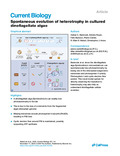
[en] Acquisition of chloroplasts by an early eukaryote and their subsequent spread across eukaryotes is well understood. However, evolution can be undone, and many important lineages (especially in the Apicomplexa) have lost photosynthesis, returning to heterotrophy. Spontaneous transition to heterotrophy remains difficult to study, as most examples happened on an evolutionary timescale. Here, we describe frequent transition to heterotrophy in a dinoflagellate alga under laboratory conditions. Dinoflagellates, close relatives of Apicomplexa, have an unusual chloroplast genome, highly reduced and fragmented into subgenomic "minicircles," each typically with a single gene encoding a component of the photosynthetic electron transfer chain. This extraordinary genome organization may predispose to loss of gene(s) essential for photosynthesis. We found that growing the dinoflagellate Symbiodinium microadriaticum (a strain able to form symbioses with corals and other Cnidaria) on medium supplemented with glucose and amino acids allowed the ready isolation of multiple strains with spontaneous partial or complete loss of photosynthetic growth, resulting from the loss of a chloroplast subgenomic minicircle. Different strains showed independent loss of a minicircle encoding one of the photosystem II (PSII) components PsbE or PsbI. Spectroscopic analysis confirmed loss/impairment of PSII and retention of photosystem I (PSI) and cyclic electron flow (CEF), probably providing ATP. This system should allow the study of the spontaneous transition to heterotrophy and the role of intermediate stages in maintaining CEF. The ready loss of photosynthesis in dinoflagellates resulting from their chloroplast genome organization may explain why dinoflagellates lost or replaced chloroplasts several times during evolution.
Disciplines :
Biochemistry, biophysics & molecular biology
Author, co-author :
Barbrook, Adrian C ✱; Department of Biochemistry, University of Cambridge, Downing Site, Tennis Court Road, Cambridge CB2 1QW, UK
Barbour, Felix; Department of Biochemistry, University of Cambridge, Downing Site, Tennis Court Road, Cambridge CB2 1QW, UK, Beijer Institute of Ecological Economics, Royal Swedish Academy of Sciences, 104 05 Stockholm, Sweden, Stockholm Resilience Centre, Stockholm University, 106 91 Stockholm, Sweden
Cardol, Pierre ; Université de Liège - ULiège > Département des sciences de la vie > Génétique et physiologie des microalgues
Nisbet, R Ellen R; School of Biosciences, University of Nottingham, Sutton Bonington Campus, Sutton Bonington, Loughborough LE12 5RD, UK. Electronic address: ellen.nisbet@nottingham.ac.uk
Howe, Christopher J ; Department of Biochemistry, University of Cambridge, Downing Site, Tennis Court Road, Cambridge CB2 1QW, UK, Stellenbosch Institute for Advanced Study (STIAS), Wallenberg Research Centre at Stellenbosch University, Stellenbosch 7600, South Africa. Electronic address: ch26@cam.ac.uk
✱ These authors have contributed equally to this work.
Language :
English
Title :
Spontaneous evolution of heterotrophy in cultured dinoflagellate algae.
Dorrell, R.G., Gile, G., McCallum, G., Meheust, R., Bapteste, E.P., Klinger, C.M., Brillet-Gueguen, L., Freeman, K.D., Richter, D.J., and Bowler, C. (2017). Chimeric origins of ochrophytes and haptophytes revealed through an ancient plastid proteome. eLife 6, e23717. 10.7554/eLife.23717.
Dorrell, R.G., and Howe, C.J. (2012). What makes a chloroplast? Reconstructing the establishment of photosynthetic symbioses. J. Cell Sci. 125, 1865-1875. 10.1242/jcs.102285.
Howe, C.J., and Nisbet, R.E.R. (2025). Phasing out photosynthesis - and weaponising chlorophyll? Trends Parasitol. 41, 339-340. 10.1016/j.pt.2025.03.014.
Wolfe, K.H., Morden, C.W., and Palmer, J.D. (1992). Function and evolution of a minimal plastid genome from a nonphotosynthetic parasitic plant. Proc. Natl. Acad. Sci. USA. 89, 10648-10652. 10.1073/pnas.89.22.10648.
Heizmann, P., Doly, J., Hussein, Y., Nicolas, P., Nigon, V., and Bernardi, G. (1981). The chloroplast genome of bleached mutants of Euglena gracilis. Biochim. Biophys. Acta 653, 412-415. 10.1016/0005-2787(81)90197-0.
Howe, C.J. (1992). Plastid origin of an extrachromosomal DNA molecule from Plasmodium, the causative agent of malaria. J. Theor. Biol. 158, 199-205. 10.1016/s0022-5193(05)80718-0.
Kim, J.I., Jeong, M., Archibald, J.M., and Shin, W. (2020). Comparative plastid genomics of non-photosynthetic chrysophytes: genome reduction and compaction. Front. Plant Sci. 11, 572703. 10.3389/fpls.2020.572703.
Smith, D.R., and Asmail, S.R. (2014). Next-generation sequencing data suggest that certain nonphotosynthetic green plants have lost their plastid genomes. New Phytol. 204, 7-11. 10.1111/nph.12919.
Mathur, V., Salomaki, E.D., Wakeman, K.C., Na, I., Kwong, W.K., Kolisko, M., and Keeling, P.J. (2023). Reconstruction of plastid proteomes of apicomplexans and close relatives reveals the major evolutionary outcomes of cryptic plastids. Mol. Biol. Evol. 40, msad002. 10.1093/molbev/msad002.
Gornik, S.G., Febrimarsa., Cassin, A.M., MacRae, J.I., Ramaprasad, A., Rchiad, Z., McConville, M.J., Bacic, A., McFadden, G.I., Pain, A., and Waller, R.F. (2015). Endosymbiosis undone by stepwise elimination of the plastid in a parasitic dinoflagellate. Proc. Natl Acad. Sci USA 112, 5767-5772. 10.1073/pnas.1423400112.
Xu, P., Widmer, G., Wang, Y., Ozaki, L.S., Alves, J.M., Serrano, M.G., Puiu, D., Manque, P., Akiyoshi, D., Mackey, A.J., et al. (2004). The genome of Cryptosporidium hominis. Nature 431, 1107-1112. 10.1038/nature02977.
Douzery, E.J.P., Snell, E.A., Bapteste, E., Delsuc, F., and Philippe, H. (2004). The timing of eukaryotic evolution: does a relaxed molecular clock reconcile proteins and fossils? Proc. Natl. Acad. Sci. USA 101, 15386-15391. 10.1073/pnas.0403984101.
Dent, R.M., Haglund, C.M., Chin, B.L., Kobayashi, M.C., and Niyogi, K.K. (2005). Functional genomics of eukaryotic photosynthesis using insertional mutagenesis of Chlamydomonas reinhardtii. Plant Physiol. 137, 545-556. 10.1104/pp.104.055244.
Jinkerson, R.E., Russo, J.A., Newkirk, C.R., Kirk, A.L., Chi, R.J., Martindale, M.Q., Grossman, A.R., Hatta, M., and Xiang, T. (2022). Cnidarian-Symbiodiniaceae symbiosis establishment is independent of photosynthesis. Curr. Biol. 32, 2402-2415.e4. 10.1016/j.cub.2022.04.021.
Rosati, G., Barsanti, L., Passarelli, V., Giambelluca, A., and Gualtieri, P. (1996). Ultrastructure of a novel non-photosynthetic Euglena mutant. Micron 27, 367-373. 10.1016/S0968-4328(96)00039-X.
Zhang, Z., Green, B.R., and Cavalier-Smith, T. (1999). Single gene circles in dinoflagellate chloroplast genomes. Nature 400, 155-159. 10.1038/22099.
Barbrook, A.C., Howe, C.J., and Nisbet, R.E.R. (2019). Breaking up is hard to do: the complexity of the dinoflagellate chloroplast genome. Perspect. Phycol. 6, 31-37. 10.1127/pip/2018/0084.
Howe, C.J., and Barbrook, A.C. (2024). Dinoflagellate chloroplasts as a model for extreme genome reduction and fragmentation in organelles - the COCOA principle for gene retention. Protist 175, 126048. 10.1016/j.protis.2024.126048.
Koumandou, V.L., and Howe, C.J. (2007). The copy number of chloroplast gene minicircles changes dramatically with growth phase in the dinoflagellate Amphidinium operculatum. Protist 158, 89-103. 10.1016/j.protis.2006.08.003.
He, J., Huang, Y., Li, L., Lin, S., Ma, M., Wang, Y., and Lin, S. (2024). Novel plastid genome characteristics in Fugacium kawagutii and the trend of accelerated evolution of plastid proteins in dinoflagellates. Genome Biol. Evol. 16, evad237. 10.1093/gbe/evad237.
Xiang, T., Jinkerson, R.E., Clowez, S., Tran, C., Krediet, C.J., Onishi, M., Cleves, P.A., Pringle, J.R., and Grossman, A.R. (2018). Glucose-induced trophic shift in an endosymbiont dinoflagellate with physiological and molecular consequences. Plant Physiol. 176, 1793-1807. 10.1104/pp.17.01572.
Pagliano, C., Saracco, G., and Barber, J. (2013). Structural, functional and auxiliary proteins of photosystem II. Photosynth. Res. 116, 167-188. 10.1007/s11120-013-9803-8.
Dorrell, R.G., and Howe, C.J. (2015). Integration of plastids with their hosts: lessons learned from dinoflagellates. Proc. Natl. Acad. Sci. USA 112, 10247-10254. 10.1073/pnas.1421380112.
Aihara, Y., Takahashi, S., and Minagawa, J. (2016). Heat induction of cyclic electron flow around Photosystem I in the symbiotic dinoflagellate Symbiodinium. Plant Physiol. 171, 522-529. 10.1104/pp.15.01886.
Van Dang, K.V., Pierangelini, M., Roberty, S., and Cardol, P. (2019). Alternative photosynthetic electron transfers and bleaching phenotypes upon acute heat stress in Symbiodinium and Breviolum spp. (Symbiodiniaceae) in culture. Front. Mar. Sci. 6, 656. 10.3389/fmars.2019.00656.
Shi, L.-X., Hall, M., Funk, C., and Schroder, W.P. (2012). Photosystem II, a growing complex: updates on newly discovered components and low molecular mass proteins. Biochim. Biophys. Acta 1817, 13-25. 10.1016/j.bbabio.2011.08.008.
Kunstner, P., Guardiola, A., Takahashi, Y., and Rochaix, J.D. (1995). A mutant strain of Chlamydomonas reinhardtii lacking the chloroplast photosystem II psbI gene grows photoautotrophically. J. Biol. Chem. 270, 9651-9654. 10.1074/jbc.270.16.9651.
Ikeuchi, M., Shukla, V.K., Pakrasi, H.B., and Inoue, Y. (1995). Directed inactivation of the psbI gene does not affect Photosystem II in the cyanobacterium Synechocystis sp. PCC 6803. Mol. Gen. Genet. 249, 622-628. 10.1007/BF00418031.
Morais, F., Barber, J., and Nixon, P.J. (1998). The chloroplast-encoded α subunit of cytochrome b-559 is required for assembly of the photosystem two complex in both the light and the dark in Chlamydomonas reinhardtii. J. Biol. Chem. 273, 29315-29320. 10.1074/jbc.273.45.29315.
Barbrook, A.C., Voolstra, C.R., and Howe, C.J. (2014). The chloroplast genome of a Symbiodinium sp. clade 3 isolate. Protist 165, 1-13. 10.1016/j.protis.2013.09.006.
Sommer, F., Hippler, M., Biehler, K., Fischer, N., and Rochaix, J.D. (2003). Comparative analysis of photosensitivity in photosystem I donor and acceptor side mutants of Chlamydomonas reinhardtii. Plant Cell Environ. 26, 1881-1892. 10.1046/j.1365-3040.2003.01105.x.
Stoecker, D.K., Hansen, P.J., Caron, D.A., and Mitra, A. (2017). Mixotrophy in the marine plankton. Annu. Rev. Mar. Sci. 9, 311-335. 10.1146/annurev-marine-010816-060617.
Coale, T.H., Loconte, V., Turk-Kubo, K.A., Vanslembrouck, B., Mak, W.K.E., Cheung, S., Ekman, A., Chen, J.-H., Hagino, K., Takano, Y., et al. (2024). Nitrogen-fixing organelle in a marine alga. Science 384, 217-222. 10.1126/science.adk1075.
Thompson, A.W., Foster, R.A., Krupke, A., Carter, B.J., Musat, N., Vaulot, D., Kuypers, M.M.M., and Zehr, J.P. (2012). Unicellular cyanobacterium symbiotic with a single-celled eukaryotic alga. Science 337, 1546-1550. 10.1126/science.1222700.
Hehenberger, E., Gast, R.J., and Keeling, P.J. (2019). A kleptoplastidic dinoflagellate and the tipping point between transient and fully integrated plastid endosymbiosis. Proc. Natl. Acad. Sci. USA 116, 17934-17942. 10.1073/pnas.1910121116.
Cooney, E.C., Holt, C.C., Jacko-Reynolds, V.K.L., Leander, B.S., and Keeling, P.J. (2023). Photosystems in the eye-like organelles of heterotrophic warnowiid dinoflagellates. Curr. Biol. 33, 4252-4260.e3. 10.1016/j.cub.2023.08.052.
Fawcett, R.C., and Parrow, M.W. (2014). Mixotrophy and loss of phototrophy among geographic isolates of freshwater Esoptrodinium/Bernardinium sp. (Dinophyceae). J. Phycol. 50, 55-70. 10.1111/jpy.12144.
Gomez, F. (2012). A quantitative review of the lifestyle, habitat and trophic diversity of dinoflagellates (Dinoflagellata, Alveolata). Syst. Biodivers. 10, 267-275. 10.1080/14772000.2012.721021.
Hehenberger, E., Imanian, B., Burki, F., and Keeling, P.J. (2014). Evidence for the retention of two evolutionary distinct plastids in dinoflagellates with diatom endosymbionts. Genome Biol. Evol. 6, 2321-2334. 10.1093/gbe/evu182.
Huot, Y., and Babin, M. (2010). Chapter 3. overview of fluorescence protocols: Theory, basic concepts, and practice. In Chlorophyll A Fluorescence in Aquatic Sciences: Methods and Applications, D.J. Suggett and O. Prasil, eds. (Springer), pp. 31-74. 10.1007/978-90-481-9268-7_3.
Klughammer, C., and Schreiber, U. (1994). An improved method, using saturating light pulses, for the determination of photosystem I quantum yield via P700+-absorbance changes at 830 nm. Planta 192, 261-268. 10.1007/BF01089043.
Klughammer, C., and Schreiber, U. (2008). Saturation Pulse method for assessment of energy conversion in PS I. PAM Application Notes 1, 11-14.
Slater, B., Kosmutzky, D., Nisbet, R.E.R., and Howe, C.J. (2021). The evolution of the cytochrome c6 family of photosynthetic electron transfer proteins. Genome Biol. Evol. 13, evab146. 10.1093/gbe/evab146.
Klughammer, C., and Schreiber, U. (2016). Deconvolution of ferredoxin, plastocyanin, and P700 transmittance changes in intact leaves with a new type of kinetic LED array spectrophotometer. Photosynth. Res. 128, 195-214. 10.1007/s11120-016-0219-0.
Bailleul, B., Cardol, P., Breyton, C., and Finazzi, G. (2010). Electrochromism: A useful probe to study algal photosynthesis. Photosynth. Res. 106, 179-189. 10.1007/s11120-010-9579-z.
Roberty, S., Bailleul, B., Berne, N., Franck, F., and Cardol, P. (2014). PSI Mehler reaction is the main alternative photosynthetic electron pathway in Symbiodinium sp., symbiotic dinoflagellates of cnidarians. New Phytol. 204, 81-91. 10.1111/nph.12903.
Vega de Luna, F., Cordoba-Granados, J.J., Dang, K.V., Roberty, S., and Cardol, P. (2020). In vivo assessment of mitochondrial respiratory alternative oxidase activity and cyclic electron flow around photosystem I on small coral fragments. Sci. Rep. 10, 17514. 10.1038/s41598-020-74557-0.
Ritchie, R.J. (2006). Consistent sets of spectrophotometric chlorophyll equations for acetone, methanol and ethanol solvents. Photosynth. Res. 89, 27-41. 10.1007/s11120-006-9065-9.