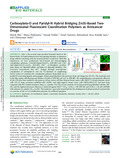
[en] Zinc is the second most prevalent biometal found in the human body. Zn-based polymers have been gaining attention as anticancer drugs without interfering with the normal activites of cell lines. With this importance, we have synthesized Zn(II)-based 2D heterobridging coordination polymers, {[Zn(tdc)(bpms)(H2O)]n, (CP-1S)} and {[Zn(tdc)(bpds)(H2O)·2H2O]n, (CP-2S)} (tdc2-, 2,5-thiophene dicarboxylate; bpms, 4,4'-dipyridyl sulfide; and bpds, 4,4'-dipyridyl disulfide). The structures demonstrate that tdc2- bridges through monodentate coordination of carboxylate-O and (O, O)-chelation to neighboring Zn(II) centers to constitute the coordination polymer; bpms/bpds act as pyridyl-N connecting ligands and propagate almost perpendicular to the previous chain and design the 2D CPs. The materials emit in the blue region with fluorescence lifetimes of 6.08 ns (CP-1S) and 5.41 ns (CP-2S). The antiproliferative and apoptotic efficacies of the CPs have been studied in the presence of four cancer cell lines (human breast cancer cells (MCF-7), human prostate cancer cells (PC-3), lung carcinoma epithelial cells (A549), and triple-negative breast cancer cells (MDA-MB-231)) and have been compared with the standard anticancer drug, i.e., cisplatin. The CPs are not cytotoxic to the human fetal lung fibroblast cell line (WI-38), and the highest anticancer efficiency is observed against MCF-7 (IC50: 14.62 ± 1.49 (CP-1S) and 24.39 ± 1.23 μM (CP-2S) with reference to cisplatin (IC50, 6 μM). This study has a great deal of potential for the development of pharmaceuticals and provides an overview of the use of coordination polymers for medicinal purposes.
Disciplines :
Chemistry
Author, co-author :
Shit, Manik ; Department of Chemistry, Jadavpur University, Jadavpur, Kolkata 700032, India
Mahapatra, Manas ; Université de Liège - ULiège > Complex and Entangled Systems from Atoms to Materials (CESAM)
Halder, Satyajit ; Division of Molecular Medicine, Bose Institute, EN 80, Sector V, Bidhan Nagar, Kolkata 700091, India
Samanta, Arnab; Department of Chemistry, Brainware University, Barasat, Kolkata 700125, India
Anas, Mahammad; Centre for Education and Research on Macromolecules (CERM), CESAM Research Unit, Department of Chemistry, University of Liege, Quartier Agora, Sart-Tilman, B6A, Liege 4000, Belgium
Jana, Kuladip; Division of Molecular Medicine, Bose Institute, EN 80, Sector V, Bidhan Nagar, Kolkata 700091, India
Sinha, Chittaranjan ; Department of Chemistry, Jadavpur University, Jadavpur, Kolkata 700032, India
Language :
English
Title :
Carboxylato-O and Pyridyl-N Hybrid Bridging Zn(II)-Based Two-Dimensional Fluorescent Coordination Polymers as Anticancer Drugs.
CSIR - Council of Scientific and Industrial Research
Funding text :
Funding from CSIR is gratefully acknowledged (Grant Number-01/3129/23/EMR-II). We are thankful to Jadavpur University for providing infrastructural support. Our sincere thanks to Dr. Basudeb Dutta (Department of Chemistry, School of Applied Sciences, Kalinga Institute of Industrial Technology (KIIT) Deemed to be University, Bhubaneswar-751024, Odisha) for helping us in structural analysis and insightful discussions. We also extend our gratitude to the Bose Institute, Kolkata, for providing instrumental facilities essential for conducting the biological studies.This study was funded by the Council of Scientific and Industrial Research (CSIR), India (Grant Number-01/3129/23/EMR-II).
Biradha, K.; Goswami, A.; Moi, R. Coordination Polymers as Heterogeneous Catalysts in Hydrogen Evolution and Oxygen Evolution Reactions. Chem. Commun. 2020, 56 (74), 10824–10842, 10.1039/D0CC04236F
Aghajani, S.; Mohammadikish, M. Sustainable Coordination Polymer-Based Catalyst and Its Application in the Nitroaromatic Hydrogenation under Mild Conditions. Langmuir 2022, 38 (28), 8686–8695, 10.1021/acs.langmuir.2c01208
Zhang, Q.; Lu, C.; Wang, R.; Han, W.; Ke, C.; Wang, S.; Zhang, X.; Wang, J. Demystifying the Coordination Polymers Triggered Fluorescence Immunoassay: State of the Art and Future Perspectives. Chem. Soc. Rev. 2023, 488, 215188, 10.1016/j.ccr.2023.215188
Thoonen, S.; Tay, H. M.; Hua, C. A Chiral Binaphthyl-Based Coordination Polymer as an Enantioselective Fluorescence Sensor. Chem. Commun. 2022, 58 (28), 4512–4515, 10.1039/D1CC06872E
Dutta, B.; Jana, R.; Bhanja, A. K.; Ray, P. P.; Sinha, C.; Mir, M. H. Supramolecular Aggregate of Cadmium(II)-Based One-Dimensional Coordination Polymer for Device Fabrication and Sensor Application. Inorg. Chem. 2019, 58 (4), 2686–2694, 10.1021/acs.inorgchem.8b03294
Lippi, M.; Cametti, M. Highly Dynamic 1D Coordination Polymers for Adsorption and Separation Applications. Coord. Chem. Rev. 2021, 430, 213661, 10.1016/j.ccr.2020.213661
Giménez-Marqués, M.; Calvo Galve, N.; Palomino, M.; Valencia, S.; Rey, F.; Sastre, G.; Vitórica-Yrezábal, I. J.; Jiménez-Ruiz, M.; Rodríguez-Velamazán, J. A.; González, M. A.; Jordá, J. L.; Coronado, E.; Espallargas, G. M. Gas Confinement in Compartmentalized Coordination Polymers for Highly Selective Sorption. Chem. Sci. 2017, 8 (4), 3109–3120, 10.1039/C6SC05122G
Imaz, I.; Rubio-Martínez, M.; García-Fernández, L.; García, F.; Ruiz-Molina, D.; Hernando, J.; Puntes, V.; Maspoch, D. Coordination Polymer Particles as Potential Drug Delivery Systems. Chem. Commun. 2010, 46 (26), 4737, 10.1039/c003084h
Ma, Z.; Moulton, B. Recent Advances of Discrete Coordination Complexes and Coordination Polymers in Drug Delivery. Coord. Chem. Rev. 2011, 255 (15–16), 1623–1641, 10.1016/j.ccr.2011.01.031
Biswas, P.; Dastidar, P. Anchoring Drugs to a Zinc(II) Coordination Polymer Network: Exploiting Structural Rationale toward the Design of Metallogels for Drug-Delivery Applications. Inorg. Chem 2021, 60 (5), 3218–3231, 10.1021/acs.inorgchem.0c03550
Kays, J. C.; Saeboe, A. M.; Toufanian, R.; Kurant, D. E.; Dennis, A. M. Shell-Free Copper Indium Sulfide Quantum Dots Induce Toxicity in Vitro and in Vivo. Nano Lett. 2020, 20 (3), 1980–1991, 10.1021/acs.nanolett.9b05259
Rezaee, T.; Fazel-Zarandi, R.; Karimi, A.; Ensafi, A. A. Metal-Organic Frameworks for Pharmaceutical and Biomedical Applications. J. Pharm. Biomed. Anal. 2022, 221, 115026, 10.1016/j.jpba.2022.115026
Wang, T.; Liu, X.; Zhu, Y.; Cui, Z. D.; Yang, X. J.; Pan, H.; Yeung, K. W. K.; Wu, S. Metal Ion Coordination Polymer-Capped pH-Triggered Drug Release System on Titania Nanotubes for Enhancing Self-Antibacterial Capability of Ti Implants. ACS Biomater. Sci. Eng. 2017, 3 (5), 816–825, 10.1021/acsbiomaterials.7b00103
Catala, L.; Mallah, T. Nanoparticles of Prussian Blue Analogs and Related Coordination Polymers: From Information Storage to Biomedical Applications. Coord. Chem. Rev. 2017, 346, 32–61, 10.1016/j.ccr.2017.04.005
Rieter, W. J.; Pott, K. M.; Taylor, K. M. L.; Lin, W. Nanoscale Coordination Polymers for Platinum-Based Anticancer Drug Delivery. J. Am. Chem. Soc. 2008, 130 (35), 11584–11585, 10.1021/ja803383k
Liu, D.; Poon, C.; Lu, K.; He, C.; Lin, W. Self-Assembled Nanoscale Coordination Polymers with Trigger Release Properties for Effective Anticancer Therapy. Nat. Commun. 2014, 5 (1), 4182, 10.1038/ncomms5182
Chandra, A.; Dutta, B.; Pal, K.; Jana, K.; Sinha, C. Designing of an Adipic Acid Bridged Zn(II) Coordination Polymer: Synthesis and Biological Study. J. Mol. Struct. 2021, 1243, 130923, 10.1016/j.molstruc.2021.130923
Shit, M.; Dey, A.; Das Mahapatra, A.; Dutta, B.; Naskar, K.; Ray, P. P.; Sinha, C. Supramolecular Assembly of an Au(III) Complex of 2-(3-phenyl-1H-1,2,4-triazol-5-yl)Pyridine: Structure, Biological Studies and Charge Transportation. Appl. Organomet. Chem. 2022, 36 (7), e6754 10.1002/aoc.6754
Chandra, A.; Das, M.; Pal, K.; Jana, S.; Dutta, B.; Ray, P. P.; Jana, K.; Sinha, C. Three-Dimensional-Coordination Polymer of Zn(II)-Carboxylate: Structural Elucidation, Photoelectrical Conductivity, and Biological Activity. ACS Omega 2019, 4 (18), 17649–17661, 10.1021/acsomega.9b01745
Wang, J.; Huang, X.; Li, H.; Yan, D.; Huang, W. Two Zn(ii) Coordination Polymers with Anticancer Drug Norcantharidin as Ligands for Cancer Chemotherapy. Dalton Trans. 2022, 51 (14), 5624–5634, 10.1039/D2DT00300G
Shit, M.; Halder, S.; Dey, A.; Dutta, B.; Chanthapally, A.; Jana, K.; Sinha, C. Pyridyl-Isonicotinoyl Hydrazone-Bridged Zn(II) Coordination Framework with Thiophenedicarboxylato Link: Structure, Biological Activity, and Electrical Conductivity. Inorg. Chem. 2023, 62 (49), 19937–19947, 10.1021/acs.inorgchem.3c02593
Shit, M.; Halder, S.; Manna, K.; Karan, A. K.; Samanta, A.; Manik, N. B.; Pal, S.; Jana, K.; Sinha, C. Mn(II) 3D Coordination Framework with Mixed 5-Aminoisophthalato and Pyridyl-Isonicotinoyl Hydrazone Bridges: Structure, Electrical Conductivity, Anticancer Activity, and Drug Delivery. ACS Appl. Polym. Mater. 2024, 6 (5), 2637–2648, 10.1021/acsapm.3c02805
Haribabu, J.; Arulkumar, R.; Mahendiran, D.; Jeyalakshmi, K.; Swaminathan, S.; Venuvanalingam, P.; Bhuvanesh, N.; Santibanez, J. F.; Karvembu, R. Effect of Coordination Mode of Thiosemicarbazone on the Biological Activities of Its Ru(II)-Benzene Complexes: Biomolecular Interactions and Anticancer Activity via ROS-Mediated Mitochondrial Apoptosis. Inorg. Chim. Acta. 2024, 565, 121973, 10.1016/j.ica.2024.121973
Swaminathan, S.; Haribabu, J.; Dharmasivam, M.; Maroli, N.; Jayadharini, J. P.; Balakrishnan, N.; Bhuvanesh, N.; Echeverria, C.; Karvembu, R. Hinged Bipodal Furoylthiourea-Based Ru(II)-Arene Complexes: Effect of (Ortho. Meta, Or para)-Substitution On Coordination And Anticancer Activity. Inorg. Chem. 2023, 62 (8), 3679–3691, 10.1021/acs.inorgchem.3c00073
Faisal, S.; Jan, H.; Shah, S. A.; Shah, S.; Khan, A.; Akbar, M. T.; Rizwan, M.; Jan, F.; Wajidullah; Akhtar, N.; Khattak, A.; Syed, S. Green Synthesis of Zinc Oxide (ZnO) Nanoparticles Using Aqueous Fruit Extracts of Myristica Fragrans: Their Characterizations and Biological and Environmental Applications. ACS Omega 2021, 6 (14), 9709–9722, 10.1021/acsomega.1c00310
Marouzi, S.; Sabouri, Z.; Darroudi, M. Greener Synthesis and Medical Applications of Metal Oxide Nanoparticles. Ceram. Int. 2021, 47 (14), 19632–19650, 10.1016/j.ceramint.2021.03.301
Kannan, K.; Radhika, D.; Sadasivuni, K. K.; Reddy, K. R.; Raghu, A. V. Nanostructured Metal Oxides and Its Hybrids for Photocatalytic and Biomedical Applications. Adv. Colloid Interface Sci. 2020, 281, 102178, 10.1016/j.cis.2020.102178
Suppiah, D. D.; Julkapli, N. M.; Sagadevan, S.; Johan, M. R. Eco-Friendly Green Synthesis Approach and Evaluation of Environmental and Biological Applications of Iron Oxide Nanoparticles. Inorg. Chem. Commun. 2023, 152, 110700, 10.1016/j.inoche.2023.110700
Mahapatra, M.; Dutta, A.; Roy, J. S. D.; Mitra, M.; Mahalanobish, S.; Sanfui, M. H.; Banerjee, S.; Chattopadhyay, P. K.; Sil, P. C.; Singha, N. R. Fluorescent Terpolymers via In Situ Allocation of Aliphatic Fluorophore Monomers: Fe(III) Sensor, High-Performance Removals, and Bioimaging. Adv. Healthcare Mater. 2019, 8 (23), 1900980, 10.1002/adhm.201900980
Mahapatra, M.; Dutta, A.; Roy, J. S. D.; Das, U.; Banerjee, S.; Dey, S.; Chattopadhyay, P. K.; Maiti, D. K.; Singha, N. R. Multi-C–C/C–N-Coupled Light-Emitting Aliphatic Terpolymers: N–H-Functionalized Fluorophore Monomers and High-Performance Applications. Chem.─Eur. J. 2020, 26 (2), 502–516, 10.1002/chem.201903935
Mahapatra, M.; Dutta, A.; Roy, J. S. D.; Deb, M.; Das, U.; Banerjee, S.; Dey, S.; Chattopadhyay, P. K.; Maiti, D. K.; Singha, N. R. Synthesis of Biocompatible Aliphatic Terpolymers via In Situ Fluorescent Monomers for Three-in-One Applications: Polymerization of Hydrophobic Monomers in Water. Langmuir 2020, 36 (22), 6178–6187, 10.1021/acs.langmuir.0c00636
Swaminathan, S.; Haribabu, J.; Karvembu, R. From Concept to Cure: The Road Ahead for Ruthenium-Based Anticancer Drugs. ChemMedchem 2024, 19 (23), e202400435 10.1002/cmdc.202400435
Swaminathan, S.; Haribabu, J.; Balakrishnan, N.; Vasanthakumar, P.; Karvembu, R. Piano Stool Ru(II)-Arene Complexes Having Three Monodentate Legs: A Comprehensive Review on Their Development as Anticancer Therapeutics over the Past Decade. Coord. Chem. Rev. 2022, 459, 214403, 10.1016/j.ccr.2021.214403
Haribabu, J.; Srividya, S.; Mahendiran, D.; Gayathri, D.; Venkatramu, V.; Bhuvanesh, N.; Karvembu, R. Synthesis of Palladium(II) Complexes via Michael Addition: Antiproliferative Effects through ROS-Mediated Mitochondrial Apoptosis and Docking with SARS-CoV-2. Inorg. Chem. 2020, 59 (23), 17109–17122, 10.1021/acs.inorgchem.0c02373
Haribabu, J.; Sabapathi, G.; Tamizh, M. M.; Balachandran, C.; Bhuvanesh, N. S. P.; Venuvanalingam, P.; Karvembu, R. Water-Soluble Mono- and Binuclear Ru(η6 - p -Cymene) Complexes Containing Indole Thiosemicarbazones: Synthesis, DFT Modeling, Biomolecular Interactions, and In Vitro Anticancer Activity through Apoptosis. Organometallics 2018, 37 (8), 1242–1257, 10.1021/acs.organomet.8b00004
Gustafsson, S.; Fornara, A.; Petersson, K.; Johansson, C.; Muhammed, M.; Olsson, E. Evolution of Structural and Magnetic Properties of Magnetite Nanoparticles for Biomedical Applications. Cryst. Growth Des. 2010, 10 (5), 2278–2284, 10.1021/cg901602w
Yang, Y.; Zhang, M.; Song, H.; Yu, C. Silica-Based Nanoparticles for Biomedical Applications: From Nanocarriers to Biomodulators. Acc. Chem. Res. 2020, 53 (8), 1545–1556, 10.1021/acs.accounts.0c00280
De, M.; Ghosh, P. S.; Rotello, V. M. Applications of Nanoparticles in Biology. Adv. Mater. 2008, 20 (22), 4225–4241, 10.1002/adma.200703183
Sperling, R. A.; Rivera Gil, P.; Zhang, F.; Zanella, M.; Parak, W. J. Biological Applications of Gold Nanoparticles. Chem. Soc. Rev 2008, 37 (9), 1896, 10.1039/b712170a
Prasad, A. S. Biochemistry of Zinc; Springer US: Boston, MA, 1993.
Sukumar, E.; Vinothkumar, K.; Manickavasagan, A.; Zinc: early Development, Applications, and Emerging Trends, 1st ed.; CRC Press: Boca Raton, 2024.
Pellei, M.; Del Bello, F.; Porchia, M.; Santini, C. Zinc Coordination Complexes as Anticancer Agents. Coord. Chem. Rev. 2021, 445, 214088, 10.1016/j.ccr.2021.214088
Dhawan, D. K.; Chadha, V. D. Zinc: A Promising Agent in Dietary Chemoprevention of Cancer. Indian J. Med. Res. 2010, 132 (6), 676–682
Bahrani, S.; Hashemi, S. A.; Mousavi, S. M.; Azhdari, R. Zinc-Based Metal–Organic Frameworks as Nontoxic and Biodegradable Platforms for Biomedical Applications: Review Study. Drug Metab. Rev. 2019, 51 (3), 356–377, 10.1080/03602532.2019.1632887
Yan, F.; Cheng, F.; Guo, C.; Liang, G.; Zhang, S.; Fang, S.; Zhang, Z. Curcumin-Regulated Constructing of Defective Zinc-Based Polymer-Metal-Organic Framework as Long-Acting Antibacterial Platform for Efficient Wound Healing. J. Colloid Interfaces Sci. 2023, 641, 59–69, 10.1016/j.jcis.2023.03.050
Marson Armando, R. A.; Abuçafy, M. P.; Graminha, A. E.; Silva, R. S. D.; Frem, R. C. G. Ru-90@bio-MOF-1: A Ruthenium(II) Metallodrug Occluded in Porous Zn-Based MOF as a Strategy to Develop Anticancer Agents. J. Solid State Chem. 2021, 297, 122081, 10.1016/j.jssc.2021.122081
Gao, B.; Wang, X.; Wang, M.; You, K.; Ahmed Suleiman, G. S.; Ren, X.; Guo, J.; Xia, S.; Zhang, W.; Feng, Y. Superlow Dosage of Intrinsically Bioactive Zinc Metal–Organic Frameworks to Modulate Endothelial Cell Morphogenesis and Significantly Rescue Ischemic Disease. ACS Nano 2022, 16 (1), 1395–1408, 10.1021/acsnano.1c09427
Murphy, J. N.; Kobti, J.-L.; Dao, M.; Wear, D.; Okoko, M.; Pandey, S.; Vukotic, V. N. Therapeutic Coordination Polymers: Tailoring Drug Release through Metal–Ligand Interactions. Chem. Sci. 2024, 15 (19), 7041–7050, 10.1039/D4SC00732H
Thurston, D. E.; Pysz, I. Chemistry and Pharmacology of Anticancer Drugs. 2nd ed.; Taylor & Francis Group. 2021.
Rossi, A.; Stagno, C.; Piperno, A.; Iraci, N.; Panseri, S.; Montesi, M.; Feizi-Dehnayebi, M.; Bassi, G.; Di Pietro, M. L.; Micale, N. Anticancer Activity and Morphological Analysis of Pt (II) Complexes: Their DFT Approach, Docking Simulation, and ADME-Tox Profiling. Appl. Organom. Chem. 2024, 38 (5), e7403 10.1002/aoc.7403
Rossi, A.; Stagno, C.; Piperno, A.; Iraci, N.; Panseri, S.; Montesi, M.; Feizi-Dehnayebi, M.; Bassi, G.; Di Pietro, M. L.; Micale, N. Anticancer Activity and Morphological Analysis of Pt (II) Complexes: Their DFT Approach, Docking Simulation, and ADME-Tox Profiling. Appl. Organomet. Chem. 2024, 38 (5), e7403 10.1002/aoc.7403
Mahapatra, M.; Bourguignon, M.; Grignard, B.; Vandevenne, M.; Galleni, M.; Detrembleur, C. Nonconventional Fluorescent Non-Isocyanate Polyurethane Foams for Multipurpose Sensing Applications. Angew. Chem., Int. Ed. 2025, 64, e202413605 10.1002/anie.202413605
Balakrishnan, N.; Haribabu, J.; Eshaghi Malekshah, R.; Swaminathan, S.; Balachandran, C.; Bhuvanesh, N.; Aoki, S.; Karvembu, R. Effect of N-Benzyl Group in Indole Scaffold of Thiosemicarbazones on the Biological Activity of Their Pd(II) Complexes: DFT, Biomolecular Interactions, in Silico Docking, ADME and Cytotoxicity Studies. Inorg. Chim. Acta. 2022, 534, 120805, 10.1016/j.ica.2022.120805
Chermette, H. Density Functional Theory: A Powerful Tool for Theoretical Studies in Coordination Chemistry. Coord. Chem. Rev. 1998, 178–180, 699–721, 10.1016/S0010-8545(98)00179-9
Haribabu, J.; Balakrishnan, N.; Swaminathan, S.; Dorairaj, D. P.; Azam, M.; Subarkhan, M. K. M.; Chang, Y.-L.; Hsu, S. C. N.; Štarha, P.; Karvembu, R. Michael Addition-Driven Synthesis of Cytotoxic Palladium(ii) Complexes from Chromone Thiosemicarbazones: Investigation of Anticancer Activity through in Vitro and in Vivo Studies. New J. Chem. 2023, 47 (33), 15748–15759, 10.1039/D3NJ02067C
Swaminathan, S.; Haribabu, J.; Mohamed Subarkhan, M. K.; Gayathri, D.; Balakrishnan, N.; Bhuvanesh, N.; Echeverria, C.; Karvembu, R. Impact of Aliphatic Acyl and Aromatic Thioamide Substituents on the Anticancer Activity of Ru(ii)- p -Cymene Complexes with Acylthiourea Ligands─ in Vitro and in Vivo Studies. Dalton Trans. 2021, 50 (44), 16311–16325, 10.1039/D1DT02611A
Haribabu, J.; Madhavan, G.; Swaminathan, S.; Panneerselvam, M.; Moraga, D.; Dasararaju, G.; Echeverria, C.; Arulraj, A.; Mangalaraja, R. V.; Kokkarachedu, V.; Santibanez, J. F.; Ramirez-Tagle, R. Multifaceted Exploration of Acylthiourea Compounds: In Vitro Cytotoxicity, DFT Calculations, Molecular Docking and Dynamics Simulation Studies. Int. J. Biol. Macromol. 2024, 278, 134870, 10.1016/j.ijbiomac.2024.134870
Balakrishnan, N.; Haribabu, J.; Dhanabalan, A. K.; Swaminathan, S.; Sun, S.; Dibwe, D. F.; Bhuvanesh, N.; Awale, S.; Karvembu, R. Thiosemicarbazone(s)-Anchored Water Soluble Mono- and Bimetallic Cu(ii) Complexes: Enzyme-like Activities, Biomolecular Interactions, Anticancer Property and Real-Time Live Cytotoxicity. Dalton Trans. 2020, 49 (27), 9411–9424, 10.1039/D0DT01309A
Karim, S.; Halder, S.; Mukherjee, S.; Debnath, U.; Misra, A. K.; Jana, K.; Das, D. Glutathione Depleting a Chemoselective Novel Pro-Oxidant Nano Metal–Organic Framework Induced G2/M Arrest and ROS-Mediated Apoptotic Cell Death in a Human Triple-Negative Breast Cancer Cell Line. ACS Appl. Mater. Interfaces 2023, 15 (22), 26442–26456, 10.1021/acsami.3c04209
Patra, R.; Halder, S.; Saha, R.; Jana, K.; Sarkar, K. Highly Efficient Photoswitchable Smart Polymeric Nanovehicle for Gene and Anticancer Drug Delivery in Triple-Negative Breast Cancer. ACS Biomater. Sci. Eng. 2024, 10 (4), 2299–2323, 10.1021/acsbiomaterials.4c00115