CP: neuroscience; affective mental state; aging; emotion inference; functional magnetic resonance imaging; medial prefrontal cortex; predictive value; representational similarity analysis; social cognition; theory of mind; uncertainty; Humans; Magnetic Resonance Imaging; Female; Male; Aged; Adult; Young Adult; Aging; Prefrontal Cortex/physiology; Emotions/physiology; Biochemistry, Genetics and Molecular Biology (all)
Abstract :
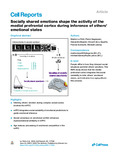
[en] The medial prefrontal cortex (mPFC) weighs options during decision-making, but its role in inferring competing emotional states and how this process changes with age, remain unclear. We recorded brain activity with functional MRI while 20 young and 40 older adults inferred the emotions of actors shown in ecological yet controlled social interactions. Socially shared representations about the timing, accuracy, and uncertainty of emotional inferences were defined using response distributions from an independent sample viewing the same scenes. mPFC activity is sensitive to emotional inference and scales with the social uncertainty of alternative emotional hypotheses. Social consensus regarding the emotional conflict elicited by the actors' interaction is associated with increased representational similarity in the mPFC, with this effect being modulated by age. Together, these results indicate that the mPFC integrates the variability of social representations to infer emotions in others and provide an account of age-related changes in social cognition.
Disciplines :
Neurosciences & behavior
Author, co-author :
Le Petit, Marine ; Université de Liège - ULiège > Département de Psychologie > Neuropsychologie de l'adulte
Gagnepain, Pierre; Normandie University, UNICAEN, PSL Université Paris, EPHE, INSERM, U1077, CHU de Caen, Centre Cyceron, Neuropsychologie et Imagerie de La Mémoire Humaine, 14000 Caen, France
Bejanin, Alexandre; Normandie University, UNICAEN, PSL Université Paris, EPHE, INSERM, U1077, CHU de Caen, Centre Cyceron, Neuropsychologie et Imagerie de La Mémoire Humaine, 14000 Caen, France, Sant Pau Memory Unit, Department of Neurology, Hospital de La Santa Creu I Sant Pau, Biomedical Research Institute Sant Pau, Universitat Autònoma de Barcelona, 08025 Barcelona, Spain, Center of Biomedical Investigation Network for Neurodegenerative Diseases (CIBERNED), 28029 Madrid, Spain
de La Sayette, Vincent; Normandie University, UNICAEN, PSL Université Paris, EPHE, INSERM, U1077, CHU de Caen, Centre Cyceron, Neuropsychologie et Imagerie de La Mémoire Humaine, 14000 Caen, France
Eustache, Francis; Normandie University, UNICAEN, PSL Université Paris, EPHE, INSERM, U1077, CHU de Caen, Centre Cyceron, Neuropsychologie et Imagerie de La Mémoire Humaine, 14000 Caen, France
Laisney, Mickaël; Normandie University, UNICAEN, PSL Université Paris, EPHE, INSERM, U1077, CHU de Caen, Centre Cyceron, Neuropsychologie et Imagerie de La Mémoire Humaine, 14000 Caen, France. Electronic address: mickael.laisney@ephe.psl.eu
Language :
English
Title :
Socially shared emotions shape the activity of the medial prefrontal cortex during inference of others' emotional states.
Premack, D., and Woodruff, G. (1978). Does the chimpanzee have a theory of mind? Behav. Brain Sci. 1, 515-526. https://doi.org/10.1017/S0140525X00076512.
Apperly, I.A. (2010). Mindreaders: The Cognitive Basis of “Theory of Mind” (Psychology Press) https://doi.org/10.4324/9780203833926.
Duclos, H., Desgranges, B., Eustache, F., and Laisney, M. (2018). Impairment of social cognition in neurological diseases. Rev. Neurol. (Paris). 174, 190-198. https://doi.org/10.1016/j.neurol.2018.03.003.
Shi, Z., and Burr, D. (2016). Predictive coding of multisensory timing. Curr. Opin. Behav. Sci. 8, 200-206. https://doi.org/10.1016/j.cobeha.2016.02.014.
Doya, K., Ishii, S., Pouget, A., and Rao, R.P.N. (2006). Bayesian Brain: Probabilistic Approaches to Neural Coding (The MIT Press) https://doi.org/10.7551/MITPRESS/9780262042383.001.0001.
Lin, C.H.S., and Garrido, M.I. (2022). Towards a cross-level understanding of Bayesian inference in the brain. Neurosci. Biobehav. Rev. 137, 104649. https://doi.org/10.1016/J.NEUBIOREV.2022.104649.
Diaconescu, A.O., Mathys, C., Weber, L.A.E., Daunizeau, J., Kasper, L., Lomakina, E.I., Fehr, E., and Stephan, K.E. (2014). Inferring on the Intentions of Others by Hierarchical Bayesian Learning. PLOS Comput. Biol. 10, e1003810. https://doi.org/10.1371/JOURNAL.PCBI.1003810.
Thornton, M.A., Weaverdyck, M.E., and Tamir, D.I. (2019). The Social Brain Automatically Predicts Others’ Future Mental States. J. Neurosci. 39, 140-148. https://doi.org/10.1523/JNEUROSCI.1431-18.2018.
FeldmanHall, O., and Shenhav, A. (2019). Resolving uncertainty in a social world. Nat. Hum. Behav. 3, 426-435. https://doi.org/10.1038/s41562-019-0590-x.
Alexander, W.H., and Brown, J.W. (2011). Medial prefrontal cortex as an action-outcome predictor. Nat. Neurosci. 14, 1338-1344. https://doi.org/10.1038/nn.2921.
Rouault, M., Lebreton, M., and Pessiglione, M. (2023). A shared brain system forming confidence judgment across cognitive domains. Cereb. cortex 33, 1426-1439. https://doi.org/10.1093/CERCOR/BHAC146.
Trudel, N., Scholl, J., Klein-Flugge, M.C., Fouragnan, E., Tankelevitch, L., Wittmann, M.K., and Rushworth, M.F.S. (2021). Polarity of uncertainty representation during exploration and exploitation in ventromedial prefrontal cortex. Nat. Hum. Behav. 5, 83-98. https://doi.org/10.1038/s41562-020-0929-3.
Spreng, R.N., and Turner, G.R. (2021). From exploration to exploitation: a shifting mental mode in late life development. Trends Cogn. Sci. 25, 1058-1071. https://doi.org/10.1016/j.tics.2021.09.001.
Brand, M., Labudda, K., and Markowitsch, H.J. (2006). Neuropsychological correlates of decision-making in ambiguous and risky situations. Neural Networks 19, 1266-1276. https://doi.org/10.1016/j.neunet.2006.03.001.
Stern, E.R., Gonzalez, R., Welsh, R.C., and Taylor, S.F. (2010). Updating beliefs for a decision: Neural correlates of uncertainty and underconfidence. J. Neurosci. 30, 8032-8041. https://doi.org/10.1523/JNEUROSCI.4729-09.2010.
De Martino, B., Bobadilla-Suarez, S., Nouguchi, T., Sharot, T., and Love, B.C. (2017). Social Information Is Integrated into Value and Confidence Judgments According to Its Reliability. J. Neurosci. 37, 6066-6074. https://doi.org/10.1523/JNEUROSCI.3880-16.2017.
Hunt, L.T., Kolling, N., Soltani, A., Woolrich, M.W., Rushworth, M.F.S., and Behrens, T.E.J. (2012). Mechanisms underlying cortical activity during value-guided choice. Nat. Neurosci. 15, 470-476. https://doi.org/10.1038/nn.3017.
Hammerer, D., Bonaiuto, J., Klein-Flugge, M., Bikson, M., and Bestmann, S. (2016). Selective alteration of human value decisions with medial frontal tDCS is predicted by changes in attractor dynamics. Sci. Rep. 6, 25160. https://doi.org/10.1038/SREP25160.
Strait, C.E., Blanchard, T.C., and Hayden, B.Y. (2014). Reward value comparison via mutual inhibition in ventromedial prefrontal cortex. Neuron 82, 1357-1366. https://doi.org/10.1016/J.NEURON.2014.04.032.
Thornton, M.A., and Tamir, D.I. (2017). Mental models accurately predict emotion transitions. Proc. Natl. Acad. Sci. USA 114, 5982-5987. https://doi.org/10.1073/PNAS.1616056114.
Grossmann, I., Huynh, A.C., and Ellsworth, P.C. (2016). Emotional complexity: Clarifying definitions and cultural correlates. J. Pers. Soc. Psychol. 111, 895-916. https://doi.org/10.1037/PSPP0000084.
Quoidbach, J., Gruber, J., Mikolajczak, M., Kogan, A., Kotsou, I., and Norton, M.I. (2014). Emodiversity and the emotional ecosystem. J. Exp. Psychol. Gen. 143, 2057-2066. https://doi.org/10.1037/A0038025.
Friston, K. (2010). The free-energy principle: a unified brain theory? Nat. Rev. Neurosci. 11, 127-138. https://doi.org/10.1038/nrn2787.
Conway, J.R., Catmur, C., and Bird, G. (2019). Understanding individual differences in theory of mind via representation of minds, not mental states. Psychon. Bull. Rev. 26, 798. 812, https://doi.org/10.3758/S13423-018-1559-X.
. Ereira, S., Hauser, T.U., Moran, R., Story, G.W., Dolan, R.J., and Kurth-Nelson, Z. (2020). Social training reconfigures prediction errors to shape Self-Other boundaries. Nat. Commun. 11, 3030. https://doi.org/10.1038/s41467-020-16856-8.
. Broom, T.W., Iyer, S., Courtney, A.L., and Meyer, M.L. (2024). Loneliness corresponds with neural representations and language use that deviate from shared cultural perceptions. Commun. Psychol. 2, 40. https://doi.org/10.1038/s44271-024-00088-3.
. Gagnepain, P., Vallee, T., Heiden, S., Decorde, M., Gauvain, J.L., Laurent, A., Klein-Peschanski, C., Viader, F., Peschanski, D., and Eustache, F. (2020). Collective memory shapes the organization of individual memories in the medial prefrontal cortex. Nat. Hum. Behav. 4, 189-200. https://doi.org/10.1038/s41562-019-0779-z.
. Molenberghs, P., Johnson, H., Henry, J.D., and Mattingley, J.B. (2016). Understanding the minds of others: A neuroimaging meta-analysis. Neurosci. Biobehav. Rev. 65, 276-291. https://doi.org/10.1016/j.neubiorev.2016.03.020.
. Van Overwalle, F., and Baetens, K. (2009). Understanding others’ actions and goals by mirror and mentalizing systems: A meta-analysis. Neuroimage 48, 564-584. https://doi.org/10.1016/j.neuroimage.2009.06.009.
. Behrens, T.E.J., Hunt, L.T., Woolrich, M.W., and Rushworth, M.F.S. (2008). Associative learning of social value. Nature 456, 245-249. https://doi.org/10.1038/nature07538.
. Diaconescu, A.O., Mathys, C., Weber, L.A.E., Kasper, L., Mauer, J., and Stephan, K.E. (2017). Hierarchical prediction errors in midbrain and septum during social learning. Soc. Cogn. Affect. Neurosci. 12, 618-634. https://doi.org/10.1093/scan/nsw171.
. Reiter, A.M.F., Kanske, P., Eppinger, B., and Li, S.C. (2017). The Aging of the Social Mind-Differential Effects on Components of Social Understanding. Sci. Rep. 7, 11046. https://doi.org/10.1038/s41598-017-10669-4.
. Zhang, L., and Glascher, J. (2020). A brain network supporting social influences in human decision-making. Sci. Adv. 6, eabb4159-eabb4159. https://doi.org/10.1126/sciadv.abb4159.
. Hampton, A.N., Bossaerts, P., and O’Doherty, J.P. (2008). Neural correlates of mentalizing-related computations during strategic interactions in humans. Proc. Natl. Acad. Sci. U. S. A. 105, 6741-6746. https://doi.org/10.1073/PNAS.0711099105.
. Yoshida, W., Seymour, B., Friston, K.J., and Dolan, R.J. (2010). Neural mechanisms of belief inference during cooperative games. J. Neurosci. 30, 10744-10751. https://doi.org/10.1523/JNEUROSCI.5895-09.2010.
. Lebreton, M., Abitbol, R., Daunizeau, J., and Pessiglione, M. (2015). Automatic integration of confidence in the brain valuation signal. Nat. Neurosci. 18, 1159-1167. https://doi.org/10.1038/nn.4064.
. Knill, D.C., and Pouget, A. (2004). The Bayesian brain: the role of uncertainty in neural coding and computation. Trends Neurosci. 27, 712-719. https://doi.org/10.1016/J.TINS.2004.10.007.
. Jenkins, A.C., and Mitchell, J.P. (2010). Mentalizing under Uncertainty: Dissociated Neural Responses to Ambiguous and Unambiguous Mental State Inferences. Cereb. Cortex 20, 404-410. https://doi.org/10.1093/CERCOR/BHP109.
Duval, C., Piolino, P., Bejanin, A., Eustache, F., and Desgranges, B. (2011). Age effects on different components of theory of mind. Conscious. Cogn. 20, 627-642. https://doi.org/10.1016/j.concog.2010.10.025.
Laillier, R., Viard, A., Caillaud, M., Duclos, H., Bejanin, A., de La Sayette, V., Eustache, F., Desgranges, B., and Laisney, M. (2019). Neurocognitive determinants of theory of mind across the adult lifespan. Brain Cogn. 136, 103588. https://doi.org/10.1016/j.bandc.2019.103588.
Moran, J.M. (2013). Lifespan development: The effects of typical ageing on theory of mind. Behav. Brain Res. 237, 32-40. https://doi.org/10.1016/j.bbr.2012.09.020.
Kemp, J., Despres, O., Sellal, F., and Dufour, A. (2012). Theory of Mind in normal ageing and neurodegenerative pathologies. Ageing Res. Rev. 11, 199-219. https://doi.org/10.1016/J.ARR.2011.12.001.
Zamarian, L., Sinz, H., Bonatti, E., Gamboz, N., and Delazer, M. (2008). Normal Aging Affects Decisions Under Ambiguity, but Not Decisions Under Risk. Neuropsychology 22, 645-657. https://doi.org/10.1037/0894-4105.22.5.645.
Fein, G., McGillivray, S., and Finn, P. (2007). Older Adults Make Less Advantageous Decisions than Younger Adults: Cognitive and Psychological Correlates. J. Int. Neuropsychol. Soc. 13, 480-489. https://doi.org/10.1017/S135561770707052X.
Caillaud, M., Bejanin, A., Laisney, M., Gagnepain, P., Gaubert, M., Viard, A., Clochon, P., de La Sayette, V., Allain, P., Eustache, F., Desgranges, B. (2020). Influence of emotional complexity on the neural substrates of affective theory of mind. Hum. Brain Mapp. 41, 139-149. https://doi.org/10.1002/hbm.24794.
Kriegeskorte, N., Mur, M., and Bandettini, P. (2008). Representational similarity analysis - connecting the branches of systems neuroscience. Front. Syst. Neurosci. 2, 4. https://doi.org/10.3389/NEURO.06.004.2008.
Viviani R. Overcoming bias in representational similarity analysis Preprint at. arXiv 2021. https://doi.org/10.48550/arXiv.2102.08931
Schurz, M., Radua, J., Aichhorn, M., Richlan, F., and Perner, J. (2014). Fractionating theory of mind: A meta-analysis of functional brain imaging studies. Neurosci. Biobehav. Rev. 42, 9-34. https://doi.org/10.1016/j.neubiorev.2014.01.009.
Abdi, H., Williams, L.J., Valentin, D., and Bennani-Dosse, M. (2012). STATIS and DISTATIS: optimum multitable principal component analysis and three way metric multidimensional scaling. WIREs Computational Stats. 4, 124-167. https://doi.org/10.1002/WICS.198.
Nee, D.E., Wager, T.D., and Jonides, J. (2007). Interference resolution: Insights from a meta-analysis of neuroimaging tasks. Cogn. Affect. Behav. Neurosci. 7, 1-17. https://doi.org/10.3758/CABN.7.1.1/METRICS.
Li, Q., Yang, G., Li, Z., Qi, Y., Cole, M.W., and Liu, X. (2017). Conflict detection and resolution rely on a combination of common and distinct cognitive control networks. Neurosci. Biobehav. Rev. 83, 123-131. https://doi.org/10.1016/J.NEUBIOREV.2017.09.032.
Preston, A.R., and Eichenbaum, H. (2013). Interplay of hippocampus and prefrontal cortex in memory. Curr. Biol. 23, R764. R773, https://doi.org/10.1016/J.CUB.2013.05.041.
Benoit, R.G., Szpunar, K.K., and Schacter, D.L. (2014). Ventromedial prefrontal cortex supports affective future simulation by integrating distributed knowledge. Proc. Natl. Acad. Sci. U. S. A. 111, 16550-16555. https://doi.org/10.1073/pnas.1419274111.
Bartra, O., McGuire, J.T., and Kable, J.W. (2013). The valuation system: A coordinate-based meta-analysis of BOLD fMRI experiments examining neural correlates of subjective value. Neuroimage 76, 412-427. https://doi.org/10.1016/j.neuroimage.2013.02.063.
Clairis, N., and Pessiglione, M. (2022). Value, confidence, deliberation: a functional partition of the medial prefrontal cortex demonstrated across rating and choice tasks. J. Neurosci. 42, 5580-5592. https://doi.org/10.1523/JNEUROSCI.1795-21.2022.
De Martino, B., Fleming, S.M., Garrett, N., and Dolan, R.J. (2013). Confidence in value-based choice. Nat. Neurosci. 16, 105-110. https://doi.org/10.1038/NN.3279.
Lin, N., Wang, X., Xu, Y., Wang, X., Hua, H., Zhao, Y., and Li, X. (2018). Fine Subdivisions of the Semantic Network Supporting Social and Sensory-Motor Semantic Processing. Cereb. Cortex 28, 2699-2710. https://doi.org/10.1093/CERCOR/BHX148.
Katayama, R., Shiraki, R., Ishii, S., and Yoshida, W. (2024). Belief inference for hierarchical hidden states in spatial navigation. Commun. Biol. 7, 614. https://doi.org/10.1038/s42003-024-06316-0.
White, T.P., Engen, N.H., Soerensen, S., Overgaard, M., and Shergill, S.S. (2014). Uncertainty and confidence from the triple-network perspective: Voxel-based meta-analyses. Brain Cogn. 85, 191-200. https://doi.org/10.1016/J.BANDC.2013.12.002.
Ondobaka, S., Kilner, J., and Friston, K. (2017). The role of interoceptive inference in theory of mind. Brain Cogn. 112, 64-68. https://doi.org/10.1016/J.BANDC.2015.08.002.
Koster-Hale, J., and Saxe, R. (2013). Theory of mind: a neural prediction problem. Neuron 79, 836-848. https://doi.org/10.1016/J.NEURON.2013.08.020.
Henson, R.N., and Gagnepain, P. (2010). Predictive, interactive multiple memory systems. Hippocampus 20, 1315-1326. https://doi.org/10.1002/hipo.20857.
Clairis, N., and Pessiglione, M. (2024). Value estimation versus effort mobilization: a general dissociation between ventromedial and dorsomedial prefrontal cortex. J. Neurosci. 44, e1176232024. https://doi.org/10.1523/JNEUROSCI.1176-23.2024.
Etkin, A., Egner, T., and Kalisch, R. (2011). Emotional processing in anterior cingulate and medial prefrontal cortex. Trends Cogn. Sci. 15, 85-93. https://doi.org/10.1016/J.TICS.2010.11.004.
Thakral, P.P., Madore, K.P., Kalinowski, S.E., and Schacter, D.L. (2020). Modulation of hippocampal brain networks produces changes in episodic simulation and divergent thinking. Proc. Natl. Acad. Sci. U. S. A. 117, 12729-12740. https://doi.org/10.1073/PNAS.2003535117/SUPPL_FILE/PNAS.2003535117.SAPP.PDF.
Martin, V.C., Schacter, D.L., Corballis, M.C., and Addis, D.R. (2011). A role for the hippocampus in encoding simulations of future events. Proc. Natl. Acad. Sci. USA 108, 13858-13863. https://doi.org/10.1073/pnas.1105816108.
Bettio, L.E.B., Rajendran, L., and Gil-Mohapel, J. (2017). The effects of aging in the hippocampus and cognitive decline. Neurosci. Biobehav. Rev. 79, 66-86. https://doi.org/10.1016/J.NEUBIOREV.2017.04.030.
Nassar, M.R., Bruckner, R., Gold, J.I., Li, S.C., Heekeren, H.R., and Eppinger, B. (2016). Age differences in learning emerge from an insufficient representation of uncertainty in older adults. Nat. Commun. 7, 11609. https://doi.org/10.1038/ncomms11609.
Reiter, A.M.F., Diaconescu, A.O., Eppinger, B., and Li, S.C. (2021). Human aging alters social inference about others’ changing intentions. Neurobiol. Aging 103, 98-108. https://doi.org/10.1016/J.NEUROBIOLAGING.2021.01.034.
Tsvetanov, K.A., Henson, R.N.A., Tyler, L.K., Davis, S.W., Shafto, M.A., Taylor, J.R., Williams, N., and Rowe, J.B., Rowe, J.B. (2015). The Effect of Ageing on fMRI: Correction for the Confounding Effects of Vascular Reactivity Evaluated by Joint fMRI and MEG in 335 Adults. Hum. Brain Mapp. 36, 2248-2269. https://doi.org/10.1002/hbm.22768.
Kitayama, S., and Park, J. (2010). Cultural neuroscience of the self: understanding the social grounding of the brain. Soc. Cogn. Affect. Neurosci. 5, 111. 129, https://doi.org/10.1093/SCAN/NSQ052.
Mesquita, B., De Leersnyder, J., and Albert, D. (2014). The cultural regulation of emotions. In The handbook of emotion regulation (Guilford Press), pp. 486-503.
Mumford, J.A., Demidenko, M.I., Bjork, J.M., Chaarani, B., Feczko E.J., Garavan H.P., Hagler D.J. Jr, and Nelson S.M., Wager, T.D., Poldrack, R.A. (2025). Unintended bias in the pursuit of collinearity solutions in fMRI analysis. Preprint at bioRxiv. https://doi.org/10.1101/2025.01.14.633053.
Fan, L., Li, H., Zhuo, J., Zhang, Y., Wang, J., Chen, L., Yang, Z., Chu, C., Xie, S., Laird, A.R., et al. (2016). The Human Brainnetome Atlas: A New Brain Atlas Based on Connectional Architecture. Cereb. Cortex 26, 3508-3526. https://doi.org/10.1093/cercor/bhw157.
Cai, M.B., Schuck, N.W., Pillow, J.W., and Niv, Y. (2019). Representational structure or task structure? Bias in neural representational similarity analysis and a Bayesian method for reducing bias. PLoS Comput. Biol. 15, e1006299-e1006299. https://doi.org/10.1371/journal.pcbi.1006299.
McLaren, D.G., Ries, M.L., Xu, G., and Johnson, S.C. (2012). A generalized form of context-dependent psychophysiological interactions (gPPI): a comparison to standard approaches. Neuroimage 61, 1277-1286. https://doi.org/10.1016/J.NEUROIMAGE.2012.03.068.
Gitelman, D.R., Penny, W.D., Ashburner, J., and Friston, K.J. (2003). Modeling regional and psychophysiologic interactions in fMRI: the importance of hemodynamic deconvolution. Neuroimage 19, 200-207. https://doi.org/10.1016/S1053-8119(03)00058-2.