Keywords :
sustainable agrosystems, pesticides, bioremediation, degrading-microorganisms, bioaugmentation
Abstract :
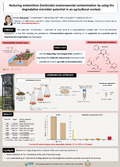
[en] Despite efforts to reduce synthetic pesticide usage, global consumption remains high due to the limited availability of effective alternatives. Synthetic pesticides, along with their biodegradation products (metabolites), significantly contribute to environmental contamination. This study examines the environmental risks of three molecules from the top five best-selling synthetic pesticides in each category (herbicide, fungicide, and insecticide) in Belgium in 2020, to develop bioremediation strategies for their degradation. The selected pesticides are not currently candidates for substitution by the EU, despite their risks to environmental quality and human health. Metamitron (114,700 kg sold in 2020) is a pre- and post-emergence herbicide used in sugar beet crops. While its half-life is 11.1 days in field conditions, it degrades into desamino-metamitron, a three times more persistent metabolite than the parent compound in the environment. However, a study (1) has shown that desamino-metamitron can be entirely mineralized in soil microcosms through microbial activity. Mandipropamid (29,763 kg sold in 2020) is a fungicide primarily used on potato crops against downy mildew, it has a half-life of 30 days in soil. Recent work (2) highlights potential biodegradation pathways, suggesting that depollution strategies can be implemented. Cypermethrin (4,048 kg sold in 2020) is an insecticide applied to cereal crops to control pests such as flies and click beetle larvae and the molecule’s half-life is 22.1 days. The biodegradation of the molecule by bacteria is well-documented (3) and leads to its complete mineralization. However, these processes are not yet adapted for field-scale application in Northern Europe. The study aims to isolate culturable microorganisms capable of degrading these pesticides and develop scalable bioremediation strategies (from microcosms to field scale). Microbial isolates are obtained from environmental sources, such as biobac samples, using enrichment cultures in mineral media with dissolved pesticides. Degradation progress is monitored daily through UPLC analysis, and microorganisms are isolated once degradation activity is observed. Isolated strains will first be tested in controlled soil-microcosms to assess their effectiveness under laboratory conditions. The ultimate goal is to create field-adapted bioremediation treatments for metamitron, mandipropamid, and cypermethrin, reducing their environmental impact and enhancing ecosystem resilience.