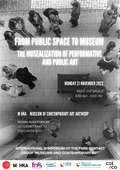
Abstract :
[en] In 1977, the International Cultural Centre (ICC) invited Gordon Matta-Clark (1943-
1978) to realize a project in an empty office building opposite the Steen in Antwerp.
The work 'Office Baroque' , made by the artist for this occasion, is intended as ‘a walk
through a panoramic arabesque’ marked by performance art’s engagement with
urban space and social dissent. Taking Matta-Clark’s structural cut as a conceptual
and methodological starting point and promoted by the FNRS Contact Group
‘Museums and Contemporary Art’, the conference will bring together scholars in
visual arts, as well as museum directors, archivists and curators to discuss from
comparative and multidisciplinary perspectives the manifold relationships
between public and performative practices with regard to the process of
musealization by contemporary art institutions. How can a live and ephemeral
action, originally conceived for the public space, become the object of a cultural
institutionalization? Once included in the collection of an art museum, in what
form is the performance preserved, exhibited and perceived? Is it a matter of
‘replaying’ it occasionally in the public space from the documentation associated
with it (photographs, films, protocols, notes, etc.), which the museum itself has
sought to perpetuate? Do the documents carry an aesthetic value? Is the
musealization of performative and public art always governed by an intent of
materialization? What status should we give to objects that are sometimes
assimilated to ‘relics’, sometimes to genuine art creations? These questions, which
deal with both reenactment practices and the controversial aspect of collecting
and archiving live or immaterial forms of art, do not exhaust the critical and the
theoretical overview of the subject. The scholarly presentations given by Mélanie
Boucher (UQO), Éric Mangion (Villa Arson, Nice), Johan Pas (AP School of Arts,
Antwerp), Annalisa Rimmaudo (MNAM – Centre Pompidou) and Pierre-Olivier
Rollin (BPS22, Charleroi) will discuss a number of seminal case studies on the issue
by underlining that there are as many performative works in the public space as
there are ways of exhibiting and perpetuating them in the museum space.