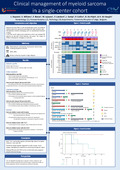
Abstract :
[en] Introduction.
Myeloid sarcoma (MS) is a rare extramedullary tumor of immature myeloid precursors, generally associated with poor prognosis. Management remains challenging, with no standardized treatment strategy. In this real-world single-center exploratory cohort, we analyzed MS patients to describe clinical features and assess the impact of different therapeutic strategies on outcomes.
Methods.
We retrospectively analyzed 10 MS patients treated at a tertiary hospital in Belgium (2021-2025), including 6 men and 4 women, with a median age of 50.5 years (range: 18–85). At diagnosis, 6/10 had de novo MS (1 isolated MS, 5 MS with synchronous bone marrow (BM) involvement), while 4/10 had relapsed MS (3 isolated MS, 1 with BM involvement) following allogeneic hematopoietic stem cell transplantation (allo-HSCT).
Among patients with de novo MS, according to patient fitness and disease characteristics, 2/6 with BM involvement received AML-type induction chemotherapy (“7+3”), one of whom also received Gemtuzumab ozogamicin; 3/6 (1 isolated, 2 with BM involvement) received with Venetoclax-Azacitidine (VenAZA), and the last one received best supportive care. All 4 relapsed MS post-allo-HSCT underwent a second allo-HSCT and radiotherapy; 2/4 also received donor lymphocyte infusions; 1/4 treated with Venetoclax-based regimen.
Results.
Median follow-up time for the whole cohort was 222 days (IQR: 135–585).
The most frequently affected site was soft tissue (7/10), including para-vertebral, muscular, cervical epiduritis, peri-aortic localization, as well as an intra-auricular polyp. The lymph nodes (3/10), the skin (3/10), and bone tissue (2/10) were also involved. Less common sites included the adrenal glands (1/10) and the testis (1/10). 4/10 had multiple-site involvement.
Molecular analysis, performed in 8 patients, identified ASXL1 as most frequent mutated gene (3/8), followed by TET2 and NRAS (2/8 each). Additional mutations were identified in SRSF2, U2AF1, FLT3, KIT, DNMT3A, IDH1, IDH2, and RUNX1 (1/8 each). Cytogenetic evaluation revealed a normal karyotype in 3/10 patients, and others showed t(8;21), complex, or hyperdiploid rearrangements.
Both patients treated with “7+3” achieved complete remission (CR), later relapsed, and are still alive. Among the 3 patients treated with VenAZA, 2 achieved CR; one of whom (with BM involvement) relapsed; and both are still alive. The third patient (also with BM involvement), did not achieve CR and died 128 days after diagnosis. All 4 relapsed MS post-allo-HSCT died 360 days after diagnosis.
Conclusions.
In this small cohort, both “7+3” and VenAZA regimens achieved high rates of complete remission in de novo MS. Interestingly, VenAZA appeared to confer a lower risk of relapse, highlighting its potential as a promising therapeutic option. It is worth noting that the patient who did not relapse had isolated MS, which is known to be associated with a more favorable prognosis.
In contrast, relapsed MS post-allo-HSCT continued to carry an extremely poor prognosis despite intensive therapy.
Importantly, the considerable heterogeneity in patients’ clinical, molecular, and genetic profiles emphasizes the need for larger, multicenter studies to refine prognostic markers and optimize treatment strategies.