Keywords :
Cliff Ecology, Microclimate, Sensor development, IoT, LoraWan
Abstract :
[en] Global change is driving rapid biodiversity loss, yet predicting species responses remains challenging because organisms experience fine-scale microclimatic conditions rather than the coarse climatic patterns typically available. To address this mismatch, researchers increasingly deploy spatial networks of low-cost microclimate sensors. However, many biodiversity studies still rely on macroclimatic data or on microclimate measurements that are inaccurate or difficult to correct. In open ecosystems exposed to direct solar radiation, measurement errors of low-cost sensors can exceed biological effect sizes, particularly for air temperature and humidity.
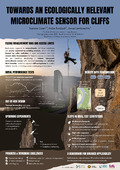
Here, we present the development of a new microclimate sensor designed to overcome these limitations. The sensor combines high-accuracy temperature and relative humidity measurements with low-power IoT-based wireless data transfer, robustness, durability, and low production costs, enabling spatial replication in hard-to-access environments. A key innovation is an “out-of-the-box” design in which temperature probes are thermally decoupled from the sensor housing, minimizing heat transfer and radiation-induced bias. This allows reliable measurements even under direct solar radiation. The sensor includes two probes: one measuring air temperature and humidity 5 cm above the substrate, and a second recording substrate contact temperature.
The first prototype targets cliff ecosystems, using vertical limestone cliffs in Belgium as a test system. Cliffs are highly exposed, structurally complex environments with strong microclimatic gradients, while sensor deployment and data retrieval require climbing or rappelling, making manual readout impractical. These characteristics make cliffs an ideal test case for remote wireless sensing, while posing major technical challenges for reliable data transmission. Sensors communicate via LoRaWAN to a central hub, with data accessible locally or remotely via LTE (4G).
By enabling accurate, continuous microclimate measurements in open and difficult-to-access ecosystems, this sensor bridges a critical gap between organismal experience and climate data, supporting improved biodiversity monitoring and predictions of ecological responses to environmental change.